
Meta Ads Compliance Guide 2026: Avoid Rejection & Bans
Meta Ads↗ Compliance Guide 2026: Policies, Special Categories & Regional Requirements
Meta's advertising ecosystem serves over three billion users across Facebook, Instagram, Messenger, and the Audience Network. As documented in Meta's Advertising Standards↗, with that reach comes an increasingly complex regulatory framework that advertisers must navigate to protect their accounts, their budgets, and their reputations. In 2026 alone, Meta has implemented 47 policy updates across its advertising platforms, marking the most significant revision cycle since the original Special Ad Categories rollout. This guide provides a comprehensive, practitioner-level walkthrough of every compliance dimension you need to master, from prohibited content and special ad categories to regional privacy regulations, industry-specific restrictions for iGaming and cryptocurrency, and the detailed appeal process for when things go wrong.
Whether you are a seasoned media buyer or a business owner running your first campaign, understanding these policies is not optional. A single compliance failure can result in ad rejection, account restriction, or permanent banishment from the platform. This guide will help you avoid those outcomes and build a sustainable, policy-compliant advertising operation on Meta.
Table of Contents
- Understanding Meta's 2026 Advertising Standards
- Prohibited Content: What Will Get Your Ad Rejected Immediately
- Restricted Content and Pre-Approval Requirements
- Special Ad Categories: Housing, Employment, Credit, and Social Issues
- iGaming and Gambling Advertising Compliance
- Cryptocurrency and Financial Product Restrictions
- Political Advertising and Social Issues
- Landing Page Requirements
- Regional Compliance: GDPR, CCPA, LGPD, and PDPA
- Creative Compliance Guidelines
- Violation Penalties: From Ad Rejection to Permanent Ban
- The Appeal Process: Step-by-Step Recovery
- Pre-Submission Compliance Checklist
- Building a Compliance-First Advertising Culture
Understanding Meta's 2026 Advertising Standards
The Three Pillars of 2026 Policy Direction
Meta's 2026 policy framework rests on three foundational pillars that reflect the platform's evolution toward proactive, AI-driven enforcement. Understanding these pillars is essential for anticipating how your ads will be reviewed and what standards they must meet.
AI Transparency is the first pillar. Meta now requires mandatory disclosure of AI-generated ad content, including images, video, and copy created or substantially modified by generative AI tools. This applies regardless of whether the AI content is photorealistic or stylized. Advertisers who fail to disclose AI-generated elements face immediate ad rejection and a compliance strike against their account health score.
Expanded HEC Enforcement represents the second pillar. The Housing, Employment, and Credit (HEC) special ad categories have been broadened in scope, and Meta's detection systems now use multimodal classifiers that analyze images for real estate imagery such as floor plans and "For Sale" signs, employment imagery like office settings and hiring banners, and credit imagery including credit card mockups and loan calculators. Even if you do not manually select a special ad category, Meta's AI will flag your ad if it detects HEC-related signals in any component of your creative.
Multimodal Review is the third pillar. Meta has transitioned from reactive enforcement, where ads were reviewed after complaints, to proactive enforcement, where every ad is scanned through AI classifiers before the first impression is served. The system simultaneously analyzes text, images, video, audio, and the destination landing page. This means inconsistencies between your ad creative and your landing page content will be caught before your ad ever reaches a user.
How Ad Review Works in 2026
When you submit an ad, it enters a multi-stage review pipeline. The first stage is automated AI classification, which typically takes seconds to minutes. The AI evaluates your creative assets, ad copy, targeting parameters, and landing page against Meta's policy database. If the AI detects a potential violation, the ad is either rejected immediately with a specific policy citation or escalated to the second stage: human review. Human review typically takes 24 to 48 hours and involves a trained policy specialist examining the ad in context. Understanding this pipeline helps you craft ads that pass both stages on the first submission. For deeper strategies on getting your ads approved quickly, see our Meta Ads Approval Guide.
Prohibited Content: What Will Get Your Ad Rejected Immediately
Prohibited content represents the hard boundaries of Meta's advertising ecosystem. Unlike restricted content, which can be advertised with proper authorization, prohibited content cannot be advertised under any circumstances, in any market, by any advertiser. Violations in this category carry the most severe account health penalties.
Discriminatory Practices
Meta's anti-discrimination policies extend beyond obvious hate speech to cover subtle forms of exclusionary targeting and messaging. Ads that promote discrimination based on race, ethnicity, national origin, religion, age, sex, sexual orientation, gender identity, family status, disability, or medical or genetic condition are prohibited globally.
Real-world case: A recruitment agency ran Facebook ads for a tech company with the headline "Looking for young, energetic developers to join our team." The ad was rejected for age discrimination in employment advertising. The word "young" was flagged as exclusionary toward older candidates. The fix involved rewriting the headline to "Looking for passionate developers to join our growing team" and ensuring the ad was classified under the Employment special ad category, which automatically removes age-based targeting options.
Real-world case: A real estate company used zip code exclusion lists in their housing ads to avoid certain neighborhoods. Meta's fair housing enforcement detected the pattern and restricted the entire ad account. The resolution required removing all geographic exclusions, switching to radius-based targeting from a central point, and submitting documentation of the company's fair housing compliance policy.
Deceptive Practices
Deceptive advertising is one of the most common reasons for ad rejection on Meta, and the definition has expanded significantly in 2026. The policy now covers misleading claims, false promises, exaggerated product benefits, fake urgency indicators, and any creative that simulates system notifications or UI elements to trick users into clicking.
Real-world case: A supplement company ran ads with before-and-after photos showing dramatic weight loss results, accompanied by the text "Lose 15 kg in 2 weeks guaranteed." The ad was rejected on two grounds: prohibited before-and-after imagery for health products and an unsubstantiated health claim. The company revised its approach by replacing the before-and-after photos with lifestyle imagery of active people, changing the copy to "Support your fitness journey with clinically studied ingredients," and adding a disclaimer linking to the clinical study. The revised ad passed review on the first submission.
Real-world case: A SaaS company designed their ad creative to look like a Facebook notification badge, complete with a red circle and number, to drive clicks. Meta classified this as a deceptive practice and rejected the ad immediately. The creative was redesigned with original branded elements that did not mimic any platform UI component.
A critical 2026 update affects influencer advertising: running UGC-style ads that simulate organic creator content without using Meta's Partnership Ads format is now classified as a "Deceptive Practice" violation, carrying immediate ad rejection and a significant account health penalty. For more on crafting compliant creative, see our guide on ad creative design principles.
Dangerous Products and Services
This category covers weapons, ammunition, explosives, illegal drugs and drug paraphernalia, tobacco products (with limited regional exceptions for smoking cessation), and unsafe dietary supplements. The enforcement is absolute: no amount of creative wordplay or euphemistic language will get these products past Meta's classifiers, which are trained on millions of examples of policy-violating content.
Adult Content and Shock Value
Sexually explicit material, adult products and services, graphic violence, and disturbing imagery are prohibited without exception. However, the boundary between acceptable and prohibited content is more nuanced than many advertisers realize. Ads for lingerie, swimwear, and fitness products are permitted as long as the imagery is not sexually suggestive or focused on body parts. When in doubt, err on the side of conservative creative and test with a small budget before scaling.
Restricted Content and Pre-Approval Requirements
Restricted content occupies the middle ground between prohibited and freely advertisable products. These categories require prior written authorization from Meta, specific targeting restrictions, mandatory disclaimers, or a combination of all three.
Alcohol Advertising
Alcohol ads must target users who meet the legal drinking age in the target market, which is 21 in the United States and 18 in most other jurisdictions. The ads must not promote excessive or irresponsible drinking, portray drinking as a solution to personal problems, or target individuals who are or appear to be underage. Each country has additional requirements: in France, for example, alcohol advertising must comply with the Loi Evin, which prohibits associating alcohol with lifestyle, sports, or social success.
Online Dating Services
Dating service advertisers must obtain written permission from Meta through the Business Suite Authorizations and Verifications portal. The ads must not contain sexually suggestive content or position the service primarily as a platform for sexual encounters. A dating app was rejected when its ad copy read "Find someone to keep you warm tonight" because the phrasing was deemed sexually suggestive. The approved revision used "Find meaningful connections in your city."
Subscription Services
Any ad promoting a subscription service must clearly disclose the billing frequency, the total cost, and the cancellation policy before the user commits. This requirement extends to free trials that convert to paid subscriptions. A fitness app had its ads rejected when the landing page buried the "$49.99/month after free trial" disclosure in small print at the bottom of the page. The fix required displaying pricing information prominently above the fold on the landing page.
Health and Medical Claims
Health advertising is among the most scrutinized categories on Meta. Guaranteed cures, miracle treatments, and unsubstantiated efficacy claims are prohibited outright. Even legitimate health products must be advertised with restraint. The platform prohibits before-and-after imagery without proper clinical context, personal attribute assertions such as "Are you struggling with diabetes?", and any claim that has not been verified by a recognized regulatory body like the FDA or EMA. General wellness content, FDA-approved products, and professional medical services with proper credentials are permitted with caution. For a deeper dive into common rejection reasons, see our article on common Meta Ads rejection fixes.
Special Ad Categories: Housing, Employment, Credit, and Social Issues
Meta's Special Ad Categories represent one of the platform's most consequential compliance requirements. Failing to declare the correct special ad category is not a minor oversight. It is treated as a serious policy violation that can result in immediate account restriction, and Meta's 2026 multimodal classifiers are remarkably effective at detecting undeclared HEC content.
Housing Ads: Restrictions and Best Practices
Housing ads cover property sales, rentals, mortgage financing, home insurance, and any housing-related service. When an ad is classified under the Housing category, Meta automatically disables demographic targeting by age, gender, and zip code. Interest-based targeting is limited to broad categories, and lookalike audiences are replaced with Special Ad Audiences that use a different, less granular matching algorithm.
Real-world case: A property management company ran rental listing ads without declaring the Housing special ad category. Their targeting included age ranges of 25 to 40 and specific zip codes in affluent neighborhoods. Meta's classifier detected the property listing imagery, cross-referenced the targeting parameters, and restricted the entire ad account for fair housing violations. The resolution process took three weeks and required the company to submit a formal fair housing compliance policy, retrain their marketing team, and rebuild their campaigns with compliant targeting.
Best practices for housing advertisers:
- Always declare the Housing special ad category, even if you believe your ad is borderline. The penalty for over-declaring is zero; the penalty for under-declaring is severe.
- Use radius-based targeting from a central point rather than zip code inclusion or exclusion lists.
- Focus ad copy on property features rather than describing the ideal tenant or buyer.
- Include an equal housing opportunity statement or logo in your creative assets.
Employment Ads: Inclusive Targeting Requirements
Employment ads encompass job postings, internship opportunities, professional certification programs, and recruitment services. The targeting restrictions mirror those of housing ads: no age, gender, or zip code targeting. The intent is to ensure equal opportunity access to employment advertising.
Real-world case: A restaurant chain ran hiring ads with the copy "Perfect part-time job for college students" and targeted the 18-to-24 age group. Both the copy and the targeting violated employment advertising policies by excluding older workers. The compliant version used the copy "Flexible part-time positions available" with broad geographic targeting and no age restrictions.
Best practices for employment advertisers:
- Use skills-based and interest-based targeting rather than demographic targeting.
- Avoid language that implies a preference for a particular age group, gender, or background.
- Include equal opportunity employer statements in your creative or landing page.
- Consider using Meta's job posting features within Facebook, which have built-in compliance guardrails.
Credit Ads: Financial Disclosure Requirements
Credit ads cover credit cards, personal loans, auto loans, mortgages, credit repair services, and banking products. A significant 2026 update: Buy Now Pay Later (BNPL) products and crypto lending platforms are now explicitly classified under the Credit category. This means all BNPL advertisers must select the Credit Special Ad Category, accept the associated targeting restrictions, and include the required financial disclaimers.
Real-world case: A fintech startup offering BNPL services ran ads without declaring the Credit special ad category because they did not consider their product a traditional credit offering. Meta's classifier flagged the ads based on landing page analysis that detected loan terms and APR disclosures, and the account was restricted. The company had to reclassify all campaigns, accept the targeting limitations, and add standardized risk warnings to their creative.
Required disclosures for credit advertising:
- Annual Percentage Rate (APR) must be accurate and prominently displayed.
- Total cost of credit over the loan term must be available before commitment.
- Risk warnings for leveraged or variable-rate products are mandatory.
- Regulatory body registration numbers must be included where applicable.
Social Issues, Elections, and Politics
This is the most heavily regulated special ad category, with requirements that extend far beyond targeting restrictions. Political and social issue advertisers must complete identity verification, display a "Paid for by" disclaimer on every ad, and have their ads archived in Meta's public Ad Library for seven years. We cover this category in depth in the dedicated section below.
iGaming and Gambling Advertising Compliance
For iGaming operators, affiliates, and marketing agencies, Meta advertising represents both an enormous opportunity and a compliance minefield. Meta updated its gambling advertising policies in July 2025 with the most comprehensive overhaul in the platform's history, and these policies remain in full effect throughout 2026. RedClaw has extensive experience navigating these requirements for our iGaming clients, and this section reflects the practical realities of running compliant gambling campaigns at scale.
The Authorization Framework
Any entity wishing to promote gambling-related content on Meta must first obtain authorization through Meta's Permissions and Verifications portal in the Business Suite. The authorization process is rigorous and country-specific. Advertisers must explicitly state their role (operator, affiliate, or service provider), submit proof of valid gambling licenses for each jurisdiction they intend to target, provide company documentation and screenshots of their platforms, and submit ad account rosters. All documentation must be submitted in English, and every application is hand-reviewed by Meta's compliance team, which typically takes 5 to 15 business days.
Only social casinos offering free-play games with no real-money wagering component are exempt from the authorization requirement. Every other gambling category, including iGaming, sports betting, poker, fantasy sports, and lottery, requires full authorization.
Country-by-Country Licensing Requirements
Meta enforces a strict country-by-country compliance model. Holding a license in one jurisdiction does not authorize advertising in another. The following table summarizes the key requirements for major iGaming markets:
| Market | Required License | Age Targeting | Additional Requirements |
|---|---|---|---|
| United Kingdom | UKGC (UK Gambling Commission) | 18+ | GambleAware messaging, no celebrity endorsements targeting under-25s |
| United States | State-specific (e.g., NYGC, NJDGE) | 21+ | Only in states where online gambling is legal; state-level geo-fencing required |
| Spain | DGOJ (Direccion General de Ordenacion del Juego) | 18+ | No bonus offers in ad creative; responsible gambling warnings mandatory |
| Italy | ADM (Agenzia delle Dogane e dei Monopoli) | 18+ | Complete advertising ban on gambling since 2019 (Dignity Decree) |
| Germany | GGL (Gemeinsame Glucksspielbehorde der Lander) | 18+ | Monthly deposit limits must be disclosed; 6 AM to 9 PM advertising window only |
| Australia | State/territory licenses | 18+ | No live-odds advertising during play; inducement restrictions vary by state |
| Philippines | PAGCOR | 21+ | Licensed offshore operators may face additional restrictions |
| Brazil | SPA (Secretaria de Premios e Apostas) | 18+ | New regulatory framework effective 2025; responsible gambling messaging required |
Affiliate and Influencer Considerations
The 2025 policy update introduced specific rules for affiliate and influencer gambling advertising. When a gambling operator mentions or features a creator in their own ad, no additional authorization is required for the creator. However, when a creator directly promotes gambling content through their own account or page, the creator must register as an affiliate, obtain separate Meta authorization, and have a signed contractual relationship with the licensed operator. Violations of this requirement are treated as unauthorized gambling advertising and carry severe penalties, including permanent account bans for both the creator and the operator.
Practical Tips for iGaming Advertisers
Based on our experience managing iGaming campaigns, here are the most common compliance pitfalls and how to avoid them:
- Do not use bonus amounts in ad headlines. In many jurisdictions, advertising specific bonus values (e.g., "Get $500 free bonus") is prohibited or restricted. Instead, focus on the platform experience and game variety.
- Always include responsible gambling messaging. A simple "18+ | Gamble Responsibly | BeGambleAware.org" (or the local equivalent) should appear in every ad creative.
- Geo-fence precisely. If you are licensed in New Jersey but not Pennsylvania, your targeting must exclude Pennsylvania entirely. Radius-based targeting that bleeds into unauthorized jurisdictions will trigger violations.
- Keep license documentation current. Meta periodically re-verifies gambling advertiser credentials. If your license expires or is not renewed, your authorization will be revoked and all ads will be paused.
For a comprehensive approach to Meta advertising strategy, see our complete Meta Ads guide.
💡 Need a compliance review? RedClaw's team specializes in navigating Meta's advertising policies for regulated industries including iGaming, crypto, and financial services. We handle authorization applications, creative compliance review, and account recovery. Get a free compliance audit →
Cryptocurrency and Financial Product Restrictions
Cryptocurrency and financial product advertising on Meta has undergone a dramatic transformation since the platform's initial blanket ban in 2018. Today, crypto advertising is permitted but heavily regulated, with a multi-layered authorization process that reflects the industry's evolving regulatory landscape.
The Crypto Ad Review Process
To advertise cryptocurrency products on Meta, advertisers must complete a dedicated Crypto Ad Review process. This involves submitting regulatory licensing documentation from a recognized financial authority (such as the FCA in the UK, BaFin in Germany, or SEC/FINRA registration in the US), providing proof of custody insurance for customer funds, and obtaining a compliance certification from a recognized auditing firm. Upon approval, advertisers receive a "Verified Crypto Advertiser" badge. Without this badge, all crypto-related ads are automatically rejected by Meta's classification system.
What Can and Cannot Be Advertised
Permitted with authorization:
- Cryptocurrency exchanges and trading platforms
- Blockchain technology services (non-speculative)
- Crypto wallet providers
- NFT marketplaces (with restrictions on financial return claims)
- Crypto educational content and courses
Prohibited regardless of authorization:
- Initial Coin Offerings (ICOs) and token sales
- Binary options
- Unregulated DeFi yield farming promotions
- Guaranteed return claims for any cryptocurrency product
- Ads promoting specific price predictions or investment outcomes
Real-world case: A crypto exchange ran ads with the headline "Bitcoin to $200K, Don't miss out, Start trading now!" The ad was rejected for making a specific price prediction and creating misleading urgency. The compliant version used "Trade Bitcoin and 200+ cryptocurrencies on our regulated platform" with a standardized risk warning: "Cryptocurrency trading carries significant risk. You may lose your entire investment."
Real-world case: A DeFi protocol attempted to advertise staking yields of "25% APY, guaranteed" on Meta. The ad was rejected on multiple grounds: unsubstantiated financial return claims, no regulatory licensing, and the use of "guaranteed" in connection with investment returns. No compliant revision was possible because the product did not meet Meta's licensing requirements.
Financial Products: Expanded Verification Requirements
As of 2026, financial services advertiser verification is mandatory in 38 countries, up from 12 in 2024. Each market requires documentation specific to the local financial regulator. For ads referencing specific interest rates, investment returns, or yield percentages, Meta now requires the use of standardized risk warning templates. Ads using non-standard risk warning text are rejected.
Required elements for financial product advertising:
- Regulatory registration number displayed in the ad or landing page
- Standardized risk disclaimer appropriate to the product category
- No targeting of users under the legal minimum age for financial products in the target market
- Clear distinction between guaranteed and variable returns
Political Advertising and Social Issues
Political and social issue advertising represents the most transparently regulated category on Meta's platform. The requirements extend beyond standard advertising compliance into the realm of democratic accountability and public transparency.
Authorization Requirements
Before running any ad related to elections, politics, or social issues of national importance, advertisers must complete Meta's identity verification process. This involves submitting government-issued identification, confirming the advertiser's physical location within the target country, and disclosing the organization or individual funding the advertisement. The "Paid for by" disclaimer is mandatory and appears on every impression of the ad, identifying the funding source to the viewing public.
What Qualifies as a Social Issue Ad
Meta defines social issues broadly, and the definition varies by country. In the United States, social issues include civil and social rights, crime, economy, education, environmental politics, guns, health, immigration, political values and governance, and security and foreign policy. An ad does not need to mention a specific candidate or election to fall under this category. A nonprofit running ads about climate change policy, for example, must comply with the full social issues advertising framework.
Real-world case: An environmental NGO ran ads about air pollution without declaring the Social Issues category because the ads did not mention any political party or candidate. Meta's classifier detected the environmental policy content and rejected the ads. The organization had to complete identity verification, add "Paid for by" disclaimers, and accept that their ads would be permanently archived in Meta's Ad Library.
Regional Variations in Political Ad Rules
Political advertising rules vary significantly by jurisdiction. In the United States, advertisers must comply with FEC regulations in addition to Meta's policies. In the European Union, the Digital Services Act (DSA) imposes additional transparency requirements, including algorithmic ranking disclosures and enhanced record-keeping. Some countries, such as Canada during election periods, require real-time disclosure of advertising spending. Meta maintains a country-specific political advertising policy page that should be consulted before running any campaign in this category. The full list of Meta Community Standards↗ provides additional context on how content moderation intersects with advertising policies.
The Ad Library and Public Accountability
All political and social issue ads are archived in Meta's Ad Library↗ and remain publicly accessible for seven years. The archive includes the ad creative, targeting parameters, spending data, and impression counts. Advertisers should assume that every political ad they run will be publicly scrutinized and plan their messaging accordingly.
Landing Page Requirements
Your landing page is not separate from your ad in Meta's compliance framework. The platform's multimodal review system analyzes your landing page as an extension of your ad creative, and inconsistencies between the two will trigger rejection.
Core Landing Page Standards
Every landing page linked from a Meta ad must include clear business identity information (company name, legal entity, and physical address), accessible contact information, a comprehensive privacy policy, and terms of service for any transactional page. The page must be fully functional, with no broken links, error pages, or content that fails to load.
Real-world case: An e-commerce brand had their ads consistently rejected despite compliant ad creative. Investigation revealed that their landing page had an aggressive pop-up that appeared immediately on load, covering the entire screen and requiring the user to enter an email address before accessing the content. Meta's policy prohibits pop-ups that prevent navigation, and the landing page was flagged as non-compliant. Removing the interstitial pop-up and replacing it with a non-blocking banner resolved the issue.
Real-world case: A lead generation company ran ads for a free consultation but the landing page redirected users through three intermediate domains before reaching the actual booking form. Meta classified this as a misleading redirect and rejected the ad. The fix required linking directly to the booking page with no intermediate redirects.
E-commerce Landing Page Requirements
Online stores must display clear pricing with currency indicators, shipping costs and delivery timeframes, a return and refund policy, and a secure checkout process with a valid SSL certificate. Product representation must be accurate: the product shown in the ad must match the product available on the landing page. Any discrepancy between ad imagery and actual product availability is treated as a deceptive practice.
Mobile Experience Standards
In 2026, with the majority of Meta ad traffic coming from mobile devices, landing pages must be mobile-optimized with responsive design, load in under three seconds on a standard mobile connection, use no interstitial ads that block content access, and provide touch-friendly navigation with appropriately sized tap targets. Pages that fail mobile experience standards may be penalized with higher CPMs even if they pass compliance review. For comprehensive tracking setup on your landing pages, see our guide on Pixel and CAPI dual tracking setup.
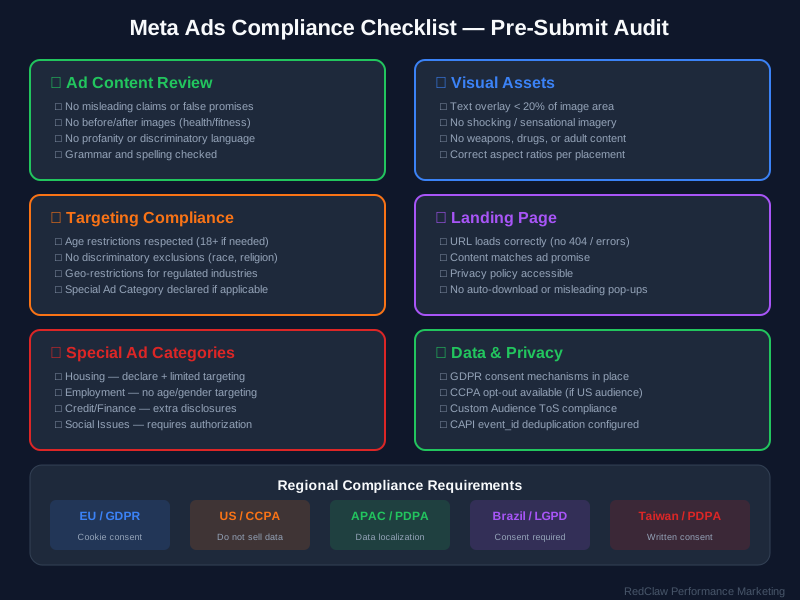
Regional Compliance: GDPR↗, CCPA, LGPD, and PDPA
Meta advertising does not exist in a regulatory vacuum. In addition to Meta's own policies, advertisers must comply with the privacy and data protection laws of every jurisdiction they target. The following comparison table provides a quick reference for the four major regulatory frameworks that affect digital advertising globally.
Comparative Overview
| Dimension | EU GDPR | US CCPA/CPRA | Brazil LGPD | APAC PDPA (Singapore) |
|---|---|---|---|---|
| Scope | All EU/EEA residents' data | California residents (revenue > $25M or 100K+ consumers) | All data processed in Brazil or of Brazilian residents | Data processed in Singapore |
| Legal Basis for Ads | Explicit consent or legitimate interest | Opt-out model; consumers can refuse sale/sharing of data | Consent, legitimate interest, or contract performance | Consent or legitimate business purpose |
| Consent Requirement | Opt-in; granular consent for each processing purpose | Opt-out; "Do Not Sell My Personal Information" link required | Opt-in for sensitive data; opt-out for non-sensitive with notice | Opt-in for marketing; deemed consent in some contexts |
| Data Subject Rights | Access, rectification, erasure, portability, objection (30-day response) | Access, deletion, opt-out, non-discrimination (45-day response) | Access, correction, anonymization, deletion, portability (15-day response) | Access, correction, withdrawal of consent (30-day response) |
| Cross-Border Transfer | Adequacy decision, SCCs, or BCRs required | No specific restrictions, but contractual safeguards recommended | Adequacy decision or specific contractual guarantees | Transfer only to countries with adequate protection |
| Maximum Penalty | 20M EUR or 4% of global annual revenue | $7,988 per intentional violation (doubled for minors' data) | 2% of revenue in Brazil, capped at 50M BRL (~$10M USD) per violation | $1M SGD per breach |
| 2025-2026 Enforcement Volume | $2.3B in fines in 2025 (38% YoY increase) | Record fines exceeding $1.3M in 2025 | $12M in fines in Q1 2025 alone | Increasing enforcement actions |
| Ad-Specific Requirements | Cookie consent banner, transparent data processing disclosure | Honor Global Privacy Control (GPC) signals, clear opt-out mechanism | Consent for behavioral targeting, transparent data use notice | Do Not Call registry compliance, marketing consent records |
Practical Implications for Meta Advertisers
The regulatory landscape has direct, practical implications for how you structure your Meta advertising campaigns. Here is what each framework means for your day-to-day operations.
GDPR (European Union): If you are targeting users in the EU or EEA, you must implement a cookie consent mechanism on your landing page that meets the "opt-in" standard. This means no tracking pixels, no Meta Pixel↗, and no Conversions API data transmission until the user has actively consented. Your Meta Pixel implementation must be conditional on consent, and your Conversions API server-side events must include consent status. Failure to comply does not just risk a Meta policy violation; it exposes you to fines of up to 4% of global revenue from EU data protection authorities. The cumulative GDPR fines since May 2018 have reached 5.88 billion EUR across 2,245 penalties, and 2025 saw $2.3 billion in fines alone, a 38% year-over-year increase. For the most current enforcement data, refer to the GDPR Enforcement Tracker↗ maintained by CMS Law.
CCPA/CPRA (California, United States): California's privacy framework operates on an opt-out model, which is less restrictive than GDPR but still imposes significant requirements. Your landing page must include a "Do Not Sell or Share My Personal Information" link, and you must honor Global Privacy Control (GPC) browser signals. A notable 2025 enforcement action saw Healthline Media fined over $1.5 million for failure to honor GPC signals and misuse of health-related data for advertising purposes. In 2026, CCPA penalties have doubled to $7,988 per intentional violation, with violations involving minors' data drawing double penalties.
LGPD (Brazil): Brazil's data protection framework has rapidly escalated enforcement, with over $12 million in fines issued during Q1 2025 alone. For Meta advertisers targeting Brazil, consent is required for sensitive data processing, and behavioral targeting requires explicit notice and consent. The LGPD's 15-day response window for data subject requests is the shortest of any major framework, requiring advertisers to have robust data management processes in place.
PDPA (Singapore and APAC): Singapore's Personal Data Protection Act requires opt-in consent for marketing communications and compliance with the Do Not Call registry. For Meta advertisers, this means ensuring your targeting excludes users who have registered on the DNC list and maintaining clear records of marketing consent for all leads generated through your campaigns.
Creative Compliance Guidelines
Image and Video Standards
Meta's creative review is more sophisticated than ever, with AI classifiers analyzing visual content for policy violations at a granular level. Prohibited elements include excessive skin exposure outside of contextually appropriate settings, shocking or sensational imagery designed to provoke an emotional reaction, misleading clickbait including fake play buttons and simulated UI elements, and copyrighted material used without proper licensing.
The Personal Attributes Policy deserves special attention because it is one of the most frequently violated rules on the platform. Your ad copy must not assert or imply personal attributes about the viewer. The table below illustrates the distinction:
| Prohibited (Asserts Personal Attribute) | Compliant (General Statement) |
|---|---|
| "Are you struggling with debt?" | "Debt consolidation services available" |
| "Meet other single Christians near you" | "Christian dating community" |
| "As a small business owner, you know..." | "Resources for small business growth" |
| "Tired of your acne?" | "Skincare solutions for clearer skin" |
| "Fellow Latino entrepreneurs, join us" | "Entrepreneur networking community" |
Real-world case: A B2B SaaS company consistently had ads rejected for personal attribute violations. Their ad copy pattern was "As a [job title], you need [product]." Every variation of this pattern was rejected because it asserted a personal attribute about the viewer. The compliant approach replaced direct assertions with benefit-focused statements: "[Product] helps teams streamline [process]."
Video Content Requirements
Video ads carry additional compliance requirements. Audio content must match the visual content, thumbnails must accurately represent the video content, captions must be accurate, and rapid flashing sequences that could trigger photosensitive epilepsy are prohibited. In 2026, video ads that use AI-generated deepfake technology or synthetic voices must include an explicit AI disclosure label.
Violation Penalties: From Ad Rejection to Permanent Ban
Meta's penalty system operates on an escalating scale tied to violation severity, frequency, and advertiser history. Understanding the penalty tiers helps you assess risk and prioritize compliance investment.
Tier 1: Ad-Level Rejection
The mildest consequence is the rejection of a specific ad. The rest of your campaigns continue running, and you can edit the rejected ad and resubmit it for review. A single ad rejection has minimal impact on your overall account health, but the violation is recorded and contributes to your cumulative risk profile. Typical causes include minor copy violations, borderline imagery, and landing page issues.
Tier 2: Ad Account Restriction
If violations accumulate or a single violation is sufficiently severe, Meta may restrict your ad account. When an account is restricted, all ads within that account are paused, and you cannot create new campaigns until the restriction is lifted. The restriction may be partial (limiting spend or certain ad types) or complete (no advertising activity permitted). Common triggers include three or more ad rejections within a 30-day period, a single serious policy violation such as undeclared special ad categories, circumventing the review system by repeatedly editing and resubmitting rejected content, and suspicious payment activity.
Tier 3: Business Manager Restriction
The most severe level of enforcement targets the Business Manager itself, affecting all ad accounts, pages, pixels, and other assets associated with the business. Business Manager restrictions are typically imposed for egregious violations such as promoting prohibited products, systematic deceptive practices, or operating unauthorized gambling or financial services advertising. Recovery from a Business Manager restriction is significantly more difficult than recovering from an ad account restriction, and in some cases, Meta may decline all appeals.
Tier 4: Permanent Ban
In extreme cases, Meta will permanently ban an advertiser from the platform. Permanent bans are issued for repeated violations after previous restrictions and warnings, operating fraudulent business models, promoting content that poses immediate harm to users, and systematic circumvention of platform policies. A permanent ban extends to the individual, not just the business entity. Creating new accounts to circumvent a permanent ban is itself a violation and will result in the immediate banning of the new account.
Account Health Score
Meta maintains an internal account health score that reflects your cumulative compliance history. Factors that affect this score include violation history and severity, appeal success rate, account age and total advertising spend, business verification status, and payment history. A high health score results in faster ad review times, lower CPMs, access to advanced features, and better support access. A low health score results in increased scrutiny, higher rejection rates, and slower review times.
The Appeal Process: Step-by-Step Recovery
When an ad is rejected or an account is restricted, the appeal process is your path to resolution. Executing it effectively requires preparation, specificity, and a professional tone.
Step 1: Identify the Violation
Before filing an appeal, you must understand exactly what was violated and why. Navigate to your Account Quality dashboard in Meta Business Suite. Select the rejected ad or restricted account on the right-hand panel to view the specific policy citation. Read the cited policy section in Meta's Advertising Standards documentation. Do not guess at the violation reason based on the ad content alone; Meta's citation will tell you exactly which policy was triggered.
Step 2: Make Corrections Before Appealing
If the violation is legitimate, correct the issue before submitting your appeal. This might involve editing ad copy to remove personal attribute assertions, replacing non-compliant imagery, updating your landing page to include required disclosures, or selecting the appropriate special ad category. Appealing without making corrections is the most common mistake advertisers make, and it wastes one of your limited appeal attempts.
Step 3: Submit the Appeal with Documentation
In the Account Quality dashboard, look for the "What You Can Do" section and click "Request Review." Your appeal should be specific about the corrections you have made, reference the relevant policy sections, explain why the original violation was unintentional if applicable, and include supporting documentation such as licenses, certifications, or compliance policies. Maintain a professional, factual tone. Avoid defensive language, accusations of unfairness, or emotional appeals.
Step 4: Wait for Review
Meta typically processes ad-level appeals within 24 to 48 hours and account-level appeals within 48 to 72 hours. During this period, do not submit additional appeals for the same issue, as this can delay the review. If you do not receive a response within 72 hours, you can follow up through the Business Help Center.
Step 5: Escalate if Necessary
If your appeal is denied and you believe the denial was incorrect, you may have the option to request a secondary review. This escalation is not always available, and it is typically reserved for cases where the advertiser can provide substantial new evidence. If all appeal options are exhausted, contact Meta Business Support directly through the Business Help Center chat or phone support (available to advertisers with significant spend history).
Critical warning: There is a time limit on appeals. If you do not appeal within the specified timeframe shown in your Account Quality dashboard, you may permanently lose the ability to request a review of that specific violation.
Pre-Submission Compliance Checklist
Use this checklist before submitting every ad to Meta. Copy it into your team's workflow and verify every item before clicking "Publish."
Ad Creative Compliance
- Ad copy does not assert or imply personal attributes about the viewer
- No before-and-after imagery for health, fitness, or cosmetic products
- No misleading claims, exaggerated benefits, or false urgency indicators
- No simulated UI elements, fake notifications, or deceptive interactive elements
- Images do not contain excessive skin exposure outside of contextually appropriate settings
- Video content includes accurate captions and no rapid flashing sequences
- AI-generated content is properly disclosed with Meta's AI label
- All imagery and music is properly licensed or original
- No profanity, graphic violence, or disturbing content
Targeting and Category Compliance
- Correct Special Ad Category selected (Housing, Employment, Credit, Social Issues) if applicable
- Age targeting meets minimum requirements for product category (18+, 21+, etc.)
- Geographic targeting is limited to jurisdictions where product/service is legally available
- No demographic exclusions that could constitute discrimination
- Restricted content authorization obtained from Meta (gambling, crypto, dating, alcohol, pharmacy)
Landing Page Compliance
- Landing page is functional with no broken links or error pages
- Business identity clearly displayed (company name, legal entity, address)
- Contact information accessible
- Privacy policy published and linked
- Terms of service available for transactional pages
- No aggressive pop-ups that prevent navigation
- No automatic downloads or misleading redirects
- Mobile-optimized with responsive design
- Page loads in under 3 seconds on mobile
- SSL certificate valid (HTTPS)
- Product/service on landing page matches ad creative
Regulatory Compliance
- Cookie consent mechanism implemented for EU/EEA targeting (GDPR)
- "Do Not Sell or Share" link present for California targeting (CCPA)
- Required financial disclaimers included for financial product ads
- Responsible gambling messaging included for iGaming ads
- "Paid for by" disclaimer included for political/social issue ads
- All required licensing and registration numbers displayed
Pre-Launch Verification
- Ad preview reviewed on all placements (Feed, Stories, Reels, Audience Network)
- Landing page tested on mobile and desktop
- All tracking pixels fire only after consent where required
- Team member other than the creator has reviewed for compliance
- Documentation of compliance review saved for audit trail
Building a Compliance-First Advertising Culture
Compliance is not a one-time checklist. It is an ongoing discipline that must be embedded in your team's culture, processes, and tools. The most successful advertisers on Meta are not the ones who never receive a rejection; they are the ones who have systems in place to minimize violations, respond quickly when they occur, and continuously improve their compliance posture.
Establish a Monthly Policy Review Cadence
Meta's policies evolve frequently, with 47 updates in 2026 alone. Assign a team member to review Meta's Transparency Center policy updates on a monthly basis and distribute a summary of changes to all campaign managers. This single practice prevents the majority of compliance failures, which stem from outdated knowledge rather than intentional violations.
Implement Pre-Submission Review
Every ad should be reviewed by at least one person other than its creator before submission. This second pair of eyes catches personal attribute violations, borderline imagery, and landing page inconsistencies that the creator may have overlooked. For high-risk categories like iGaming, financial services, and health products, consider requiring a third review from a compliance specialist.
Document Your Compliance Decisions
Maintain a record of every compliance review, including what was checked, who reviewed it, and what changes were made. This documentation serves two purposes: it creates an audit trail that can support appeals if a compliant ad is incorrectly rejected, and it builds institutional knowledge about what works and what does not on Meta's platform.
Invest in Account Health
Your account health score is an asset that compounds over time. Verified businesses with clean compliance histories enjoy faster review times, lower CPMs, and better support access. Protect this asset by addressing violations promptly, training your team thoroughly, and erring on the side of caution when a compliance question is ambiguous.
Meta Ads compliance in 2026 is more complex than it has ever been, but the fundamental principle remains simple: advertise honestly, respect your audience, and stay informed about the rules. By treating compliance as a competitive advantage rather than a bureaucratic burden, you position your business for sustainable, long-term success on the world's largest advertising platform.
💡 Running ads in a regulated industry? RedClaw's media buying team has deep expertise in compliant campaign management for iGaming, crypto, and financial services. From authorization applications to ongoing creative review, we keep your accounts healthy and your ads live. Learn more about our media buying services →
Navigating Meta's compliance landscape requires specialized expertise, especially in regulated industries like iGaming, cryptocurrency, and financial services. RedClaw Performance provides end-to-end compliance management, from pre-submission creative review and special ad category configuration to appeal handling and account recovery. Our compliance team stays current with every policy update so your campaigns stay live and your accounts stay healthy. Contact us for a compliance audit of your current Meta advertising setup.
Related Posts
Complete Guide to Choosing an iGaming Advertising Agency: 2026 Evaluation Criteria & Service Comparison
Expert guide on how to choose an iGaming advertising agency. Covers evaluation criteria, service comparison, pricing structures, and frequently asked questions. Find the best iGaming advertising agency partner for your business.
iGaming Player Psychology: The Science Behind Why Players Click, Engage, and Convert
Discover the psychological triggers driving iGaming player behavior. Learn how dopamine loops, cognitive biases, and player archetypes influence conversion rates. Data-driven insights for 2026.
Wrong Wallet: How a DeFi Protocol Spent $52K Targeting Web2 Users Who Had Never Touched Crypto
A DeFi lending protocol ran Google Ads targeting 'investment' and 'savings account' keywords, attracting traditional finance users with zero crypto literacy. Conversion rate was 0.12% because the landing page assumed wallet connectivity knowledge.