
Meta Ads Audience Targeting 2026: Advanced Strategies
Advanced Meta Ads↗ Audience Targeting: Lookalike, Custom & Advantage+ Strategies (2026)
Audience targeting on Meta has undergone a fundamental transformation. The days of stacking dozens of interest layers and hoping for precision are behind us. In 2026, success comes from understanding how to leverage AI-driven optimization while strategically using audience signals to guide the algorithm --- and knowing exactly when manual control still outperforms automation.
This guide is not a surface-level overview. It is a practitioner-level playbook covering every advanced audience strategy available on Meta today, from building high-performing Lookalike Audiences to diagnosing audience overlap issues that silently drain your budget. Whether you are scaling an e-commerce brand, generating leads for a SaaS product, or managing performance campaigns for regulated industries, the frameworks here will give you a measurable edge.
Table of Contents
- The 2026 Targeting Paradigm Shift
- Audience Types Overview
- Custom Audience Advanced Strategies
- Lookalike Audience: Complete Step-by-Step Setup
- Value-Based Lookalike Audiences
- Engagement Custom Audiences
- Product Catalog Audiences and Dynamic Retargeting
- Advantage+ Audience vs. Manual Targeting
- Audience Overlap Diagnosis and Exclusion Strategy
- Audience Segmentation by Funnel Stage
- 2026 Privacy Changes and Their Impact on Targeting
- Measurement, Testing, and Optimization
The 2026 Targeting Paradigm Shift
From Manual Precision to AI-Guided Signal Feeding
The traditional approach of detailed interest layering and demographic filtering has given way to AI-powered audience discovery. Meta merged hundreds of granular interest options into broader categories throughout 2025 --- "Jazz Guitar" became "Jazz Music," specific car models folded into general automotive, and niche food preferences were consolidated. As of January 15, 2026, any ad sets still using removed targeting options stopped delivery entirely.
This is not a loss of capability. It is a redirection. Meta's algorithm now processes billions of behavioral signals to find your ideal customers, and the advertiser's role has shifted from "telling Meta who to target" to "giving Meta the right signals so it can find the best people."
| Old Approach (2020--2023) | New Approach (2026) |
|---|---|
| Narrow interest targeting | Broad targeting + strong creative |
| Multiple ad sets by interest | Consolidated ad sets, creative variation |
| Manual bid adjustments | Automated bidding strategies |
| Demographic restrictions | Algorithmic optimization |
| Exclusion-heavy strategies | Inclusion-based expansion |
| Deterministic tracking only | Probabilistic + AI-modeled attribution |
Why Broad Targeting Works Now
Meta's AI processes signals that no human could manually target against:
- On-platform behavior: Every like, comment, share, and scroll pause
- Content engagement patterns: What types of posts hold attention
- Purchase intent signals: Actions correlated with buying behavior across Meta's ecosystem
- Cross-device activity: Linking desktop research to mobile purchase
- Lookalike pattern matching: Finding statistical twins of your best customers
- Conversion modeling: AI-inferred conversions for users who opted out of tracking
The algorithm knows more than you can target. A single 1% Lookalike audience built from high-LTV customers will consistently outperform a hand-crafted stack of 15 interest layers, because the algorithm evaluates thousands of micro-signals that are not available as targetable interests.
When Manual Targeting Still Wins
Despite the broad targeting trend, specific targeting remains valuable and often necessary for:
- Niche B2B audiences where the total addressable market is small (under 500K people)
- Geographic constraints such as local businesses or region-locked services
- Age-restricted products including alcohol, gambling, and financial products
- Special ad categories (housing, employment, credit) where Meta restricts targeting options
- New accounts with no pixel data where the algorithm has nothing to learn from
- Market expansion into countries where you have zero existing customer data
For a comprehensive foundation before diving into advanced strategies, see our Meta Ads Complete Guide.
Audience Types Overview
Before diving into specific strategies, it helps to understand how every audience type maps to your marketing funnel. The following matrix illustrates which audience types are most effective at each stage of the customer journey.
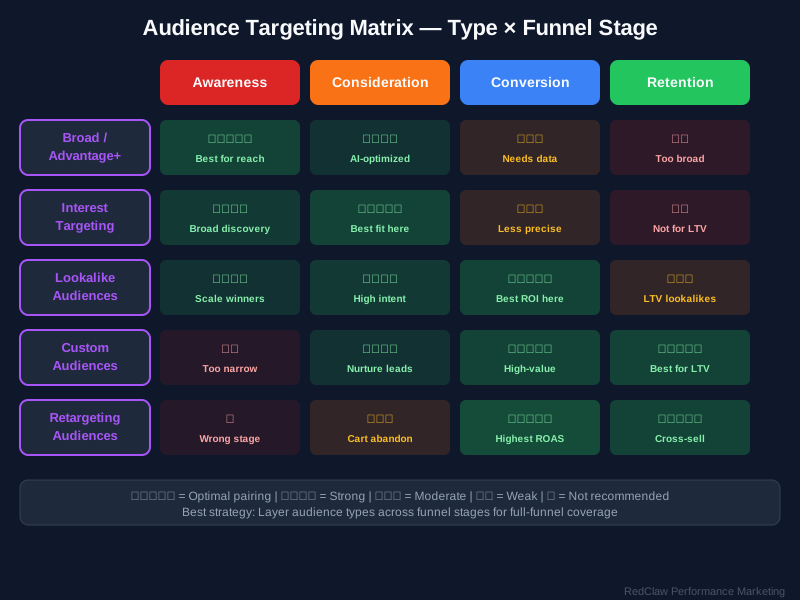
Here is a summary of the primary audience types available on Meta in 2026:
| Audience Type | Source | Best Funnel Stage | Typical Size | Key Advantage |
|---|---|---|---|---|
| Broad (Open) | No restrictions | TOF Prospecting | Millions | Maximum reach, AI-optimized |
| Interest-Based | Meta's categorization | TOF / MOF | 1M--50M | Directional signal for niche markets |
| Lookalike (1%) | Your seed audience | TOF Prospecting | ~2M per country | High-quality prospecting at scale |
| Lookalike (3--5%) | Your seed audience | TOF Expansion | ~5M--10M | Broader prospecting with decent quality |
| Value-Based Lookalike | Customer list + LTV | TOF Prospecting | ~2M per country | Optimized for high-value customers |
| Website Custom Audience | Pixel / CAPI↗ events | MOF / BOF | Varies | Intent-based retargeting |
| Engagement Custom Audience | On-platform actions | MOF | Varies | Warm audience, no pixel needed |
| Customer List | CRM upload | BOF / Retention | Varies | First-party data, highest intent |
| Product Catalog | Catalog + events | BOF Retargeting | Varies | Dynamic product-level retargeting |
| Advantage+ Audience | AI-driven | Full Funnel | Maximum | Fully automated, lowest management |
Custom Audience Advanced Strategies
Custom Audiences are the foundation of every sophisticated Meta Ads strategy. As outlined in Meta's Custom Audiences documentation↗, they let you re-engage people who have already interacted with your business, and they serve as the seed data for your Lookalike Audiences. Getting this right is the difference between a 2x ROAS and a 5x ROAS.
Website Visitor Segmentation
Basic retargeting (showing the same ad to everyone who visited your site in the last 30 days) is a beginner mistake. Advanced advertisers segment their website visitors into distinct audiences based on behavior quality and intent signals.
By Page Category: Create separate audiences for visitors to different sections of your site. Someone who visited your pricing page has fundamentally different intent than someone who read a blog post.
| Audience Segment | Retention Window | Intent Level | Recommended Action |
|---|---|---|---|
| Homepage only | 30 days | Low | Awareness creative, brand story |
| Blog readers (3+ articles) | 60 days | Medium | Educational content, lead magnet |
| Service/Product page viewers | 14 days | High | Feature-focused ads, social proof |
| Pricing page visitors | 7 days | Very High | Offer-based ads, urgency messaging |
| Cart abandoners | 3 days | Highest | Dynamic product ads, incentive |
By Engagement Depth: Use time-on-site and scroll depth to separate casual visitors from genuinely engaged prospects. A visitor who spent 3 minutes reading your case study page is far more valuable than someone who bounced after 5 seconds.
- Time on site > 60 seconds: Engaged visitor, worth retargeting with mid-funnel content
- Time on site > 180 seconds: High-quality prospect, worth aggressive retargeting
- Scroll depth > 75%: Content consumer, strong candidate for lead generation ads
- Multiple page views (3+): Active researcher, ready for bottom-funnel offers
To track these engagement signals accurately, you need proper Pixel and CAPI dual tracking setup --- without it, your Custom Audiences will be incomplete and unreliable.
Event-Based Audiences
Meta's standard events let you build audiences around specific actions that indicate purchase intent. Each event type warrants its own strategy.
Purchase Event Audiences:
- When to use: Exclusion from prospecting, seed for Lookalikes, upsell/cross-sell campaigns
- Retention window: 180 days for exclusion, 60 days for active upsell
- Expected effect: Using purchasers as Lookalike seeds typically produces 30--50% higher ROAS than using all website visitors
- Strategy: Segment by purchase value --- create separate audiences for customers who spent above and below your average order value
AddToCart Event Audiences:
- When to use: High-intent retargeting for users who showed purchase intent but did not convert
- Retention window: 7--14 days (intent decays rapidly)
- Expected effect: Cart abandonment retargeting typically achieves 5--12x ROAS because these users were moments from purchasing
- Strategy: Combine with dynamic product ads to show the exact items left in cart, paired with urgency messaging or a small discount
Lead Event Audiences:
- When to use: Lead nurturing sequences, moving leads from form submission to sales conversation
- Retention window: 30--90 days depending on sales cycle
- Expected effect: Lead retargeting campaigns typically see 40--60% lower cost per qualified lead compared to cold prospecting
- Strategy: Exclude leads that have already been contacted by your sales team (upload a suppression list weekly)
ViewContent (Product View) Audiences:
- When to use: Mid-funnel retargeting for browsers who explored specific products
- Retention window: 14--30 days
- Expected effect: Product viewer retargeting yields 3--7x ROAS on average
- Strategy: Layer with frequency caps to prevent ad fatigue --- show no more than 4--5 impressions per week
LTV-Based Customer Segmentation
Not all customers are equal. A customer who spends $5,000 per year is worth dramatically more as a Lookalike seed than one who made a single $20 purchase. Segmenting your customer list by lifetime value unlocks the most powerful targeting capabilities on Meta.
Creating LTV Tiers:
- Platinum (Top 10%): Your highest-value customers. Use as seeds for Value-Based Lookalikes. These produce the highest-quality prospecting audiences.
- Gold (Top 11--30%): Strong customers with room for growth. Target with upsell and loyalty campaigns.
- Silver (Top 31--60%): Average customers. Use for broad Lookalike seeds when you need larger reach.
- Bronze (Bottom 40%): Low-value or one-time buyers. Exclude from high-value Lookalike seeds. May be worth win-back campaigns.
Implementation: Export your CRM data with customer email, phone, name, city, and a "customer_value" column. Upload to Meta as a Customer List Custom Audience and toggle "Include customer value" during upload. Meta will weight the Lookalike algorithm toward finding people similar to your highest-value customers.
CRM Upload Best Practices
Your customer list match rate directly impacts audience quality. A 30% match rate means Meta can only find 30% of your customers on the platform, which produces a smaller and potentially less representative seed audience.
Maximizing Match Rate:
- Include multiple identifiers: Email alone gets 40--60% match. Adding phone number pushes it to 60--75%. Adding first name, last name, city, and country can reach 80%+.
- Normalize data before upload: Lowercase all emails, remove spaces, use consistent phone number formatting (include country code).
- Use personal emails: Business email addresses (company domains) match at significantly lower rates than Gmail, Yahoo, or Outlook addresses.
- Refresh monthly: Customer data goes stale quickly. People change email addresses, phone numbers, and locations. Upload a fresh list at least once per month.
- Minimum viable size: Meta requires at least 100 people for a Custom Audience, but realistically you need 1,000+ for meaningful Lookalike performance, and 5,000+ for optimal results.
- Hash before upload: Meta hashes data automatically, but pre-hashing with SHA-256 gives you more control over data security and ensures compliance with privacy regulations.
Lookalike Audience: Complete Step-by-Step Setup
Lookalike Audiences remain one of the most powerful prospecting tools on Meta, even as Advantage+ has gained prominence. According to Meta's Lookalike Audiences guide↗, a well-built Lookalike from a high-quality seed audience consistently outperforms interest targeting and often rivals or beats Advantage+ for specific verticals.
Step 1: Choose Your Source Audience
The quality of your Lookalike depends entirely on the quality of your seed. Here is how different source audiences typically perform:
| Source Audience | Seed Size Needed | Expected ROAS Impact | Best For |
|---|---|---|---|
| Top 10% LTV customers | 1,000--5,000 | Highest (baseline + 40--60%) | Premium prospecting |
| All purchasers (180 days) | 2,000--10,000 | High (baseline + 20--35%) | Balanced volume + quality |
| Value-based customer list | 1,000--5,000 | Highest for e-commerce | Finding high-AOV customers |
| Website purchasers (Pixel) | 500--5,000 | Good (baseline + 15--25%) | When CRM data is limited |
| Lead form submitters | 1,000+ | Medium-high | Lead generation campaigns |
| Email subscribers | 5,000+ | Medium | Broad awareness campaigns |
| Video viewers (95%) | 10,000+ | Medium | Top-of-funnel expansion |
| Page/Profile engagers | 10,000+ | Lower | Maximum reach campaigns |
Critical Rule: Always prioritize quality over size. A seed audience of 1,000 high-LTV customers will outperform a seed of 50,000 email subscribers every time. Meta's algorithm needs clear "this is what a great customer looks like" signal, not noise.
Step 2: Create the Lookalike in Ads Manager
Follow these steps exactly:
- Navigate to Ads Manager and click Audiences in the left menu (or go to business.facebook.com/adsmanager/audiences)
- Click Create Audience and select Lookalike Audience
- Under Select your Lookalike source, choose your Custom Audience (the seed). If you do not see it, ensure the Custom Audience has finished processing (this can take up to 72 hours for large lists)
- Under Select audience location, choose the country or countries where you want to find similar people. Choose the countries where you actively advertise --- do not add countries you have no intention of targeting
- Under Select audience size, choose your percentage. Start with 1% for your first test
- Click Create Audience. Processing takes 6--24 hours. Do not use the audience in campaigns until processing is complete.
Step 3: Select the Right Percentage
The percentage controls how similar the Lookalike audience is to your seed. Lower percentages mean higher similarity but smaller reach.
1% Lookalike (Recommended Starting Point)
- Size: Approximately 2 million people per country (varies by country population)
- Similarity: Highest
- When to use: First launch, limited budget, premium products, high-AOV campaigns
- Expected performance: ROAS is typically 30--50% higher than a 5% Lookalike from the same seed
- Budget allocation: Start here with 60--70% of your prospecting budget
2--3% Lookalike (Scaling)
- Size: 4--6 million people per country
- Similarity: High
- When to use: When 1% is fully saturated (frequency exceeds 2.5 per week), scaling phase
- Expected performance: 10--20% lower ROAS than 1%, but significantly more reach
- Budget allocation: Move 30--40% of budget here after 1% proves profitable
5% Lookalike (Broad Expansion)
- Size: ~10 million per country
- Similarity: Moderate
- When to use: Large-budget campaigns, mass-market products, brand awareness objectives
- Expected performance: ROAS typically 40--60% lower than 1%, but CPM is often 15--25% cheaper
- Budget allocation: Test with 10--15% of budget
10% Lookalike (Near-Broad)
- Size: ~20 million per country
- Similarity: Low
- When to use: Rarely recommended. At this size, you are essentially running broad targeting with a slight directional signal. Better to use Advantage+ or true broad targeting instead.
Step 4: Seed Audience Size Recommendations
Meta's official minimum is 100 people, but practical minimums are much higher:
- 100--500 people: Functional but unreliable. The algorithm does not have enough data points to identify consistent patterns. Use only if this is genuinely all the data you have.
- 1,000--3,000 people: Good performance for most use cases. Sufficient for the algorithm to identify meaningful patterns.
- 3,000--10,000 people: Optimal range. Large enough for statistical significance, focused enough to maintain quality signal.
- 10,000--50,000 people: Excellent for broad Lookalikes (3--5%). May dilute signal quality for 1% if the audience itself is broad.
- 50,000+ people: Quality of the seed matters more than ever. Ensure this large list is genuinely high-quality, not just "anyone who ever visited your site."
Step 5: Lookalike Refresh Strategy
Lookalike Audiences are not "set and forget." Their performance degrades as your customer base evolves and Meta's user base shifts.
- Monthly: Refresh the underlying Custom Audience with updated customer data. If your seed is a Customer List, re-upload with the latest CRM export.
- Quarterly: Test new Lookalike percentages and compare against existing ones. A 2% from Q1 data may outperform a 1% from last year's data.
- After major changes: If you launch a new product, enter a new market, or significantly change your pricing, rebuild your Lookalikes from scratch --- the "ideal customer" profile may have shifted.
Value-Based Lookalike Audiences
Value-Based Lookalikes are the most underutilized advanced targeting feature on Meta. Instead of telling the algorithm "find people similar to my customers," you are telling it "find people similar to my best customers, weighted by how much each one is worth."
How Value-Based Lookalikes Differ
A standard Lookalike treats all seed audience members equally. A Value-Based Lookalike assigns different weights based on the customer value you provide. This means a customer who spent $10,000 influences the Lookalike model far more than a customer who spent $50.
Performance advantage: Value-Based Lookalikes typically produce 15--25% higher ROAS than standard Lookalikes from the same customer list, because the algorithm specifically optimizes for finding high-value prospects, not just any prospect.
Setup Process
- Prepare your customer list CSV with the standard fields (email, phone, name, etc.) plus a "value" column containing the numeric customer value (total purchase amount, LTV score, or any revenue metric)
- In Audiences, click Create Audience then Custom Audience then Customer List
- Upload your CSV. When prompted, toggle on "Include a column for customer value" and map it to the correct column
- Wait for processing (24--72 hours for large lists)
- Create a Lookalike from this value-based Custom Audience using the standard process
- Meta will automatically weight the Lookalike algorithm toward your highest-value customers
When to Use Value-Based Lookalikes
- E-commerce with wide AOV range: If your orders range from $20 to $2,000, a standard Lookalike will optimize for the average. A Value-Based Lookalike will skew toward the $2,000 buyers.
- SaaS with tiered pricing: Enterprise customers worth $50K/year should carry more weight than free trial signups.
- Lead generation with variable quality: Not all leads convert equally. Assign value based on closed-won revenue, not just "submitted a form."
- Any business where customer value varies by more than 5x between your best and worst customers.
Best Practices
- Use revenue data, not arbitrary scores. Meta's algorithm works best with real monetary values.
- Include at least 1,000 customers with value data. Below this threshold, the value-weighting becomes statistically unreliable.
- Update quarterly as customer values change. A customer who was Bronze tier six months ago may now be Platinum.
- Test against standard Lookalikes: Run both side by side with identical creative and budgets for 2--3 weeks to measure the actual ROAS lift.
📊 Try it yourself: Use our free Budget Planner to model how different audience strategies impact your campaign economics before committing ad spend.
Engagement Custom Audiences
Engagement Custom Audiences capture people who have interacted with your brand on Meta's platforms --- no Pixel or CAPI required. This makes them invaluable for businesses with limited website tracking capability or those in verticals where privacy regulations restrict pixel-based tracking.
Instagram Engager Audiences
Instagram engagement audiences are particularly powerful because Instagram interaction signals (likes, comments, saves, shares, DMs) indicate genuine interest rather than passive scrolling.
Available Segments:
| Segment | Retention Window | Quality Signal | Recommended Use |
|---|---|---|---|
| Anyone who engaged with your professional account | Up to 365 days | Medium | Broad warm retargeting |
| People who visited your profile | Up to 365 days | Medium-High | Brand interest indicator |
| People who saved any post or ad | Up to 365 days | High | High purchase intent |
| People who engaged with any post or ad | Up to 365 days | Medium | General warm audience |
| People who sent a message | Up to 365 days | Highest | Direct inquiry, sales-ready |
Strategy:
- Use "saved post" audiences as Lookalike seeds --- people who save your content are signaling strong purchase intent
- Create a layered retargeting sequence: profile visitors get awareness content, engagers get consideration content, message senders get conversion offers
- Expected effect: Instagram engager retargeting typically produces 3--5x ROAS at 50--70% lower CPM than website retargeting, because these audiences are reached natively on the platform
Facebook Page Engagement Audiences
Similar to Instagram but with some unique segments:
- People who engaged with your Page (liked, commented, shared, clicked): Use as a broad warm audience for retargeting or as a supplementary Lookalike seed
- People who clicked any CTA button: Higher intent than general engagement. Good for MOF retargeting.
- People who sent a message to your Page: Highest intent. Treat these like warm leads.
When to use: Facebook Page audiences are especially valuable for local businesses, service businesses, and B2B companies where the sales cycle involves multiple touchpoints and conversations.
Video Viewer Audiences
Video viewer audiences are segmented by completion percentage, which directly correlates with interest level:
- 3-second views (ThruPlay): Large audience, low quality. Use only for broad Lookalikes when you need maximum seed size.
- 25% viewers: Initial curiosity. Good for awareness retargeting.
- 50% viewers: Moderate interest. Worth retargeting with educational content.
- 75% viewers: Strong interest. Ready for product-focused messaging.
- 95% viewers: Maximum intent from video. Use as a premium Lookalike seed or for direct-response retargeting.
Strategy: Create a "video engagement funnel" --- run a broad awareness video campaign at TOF, then retarget 50%+ viewers with product demos, then retarget 95% viewers with conversion offers. This approach typically reduces overall CPA by 25--40% compared to going straight to conversion campaigns because you are pre-qualifying audiences through content consumption.
Expected effect: A Lookalike built from 95% video viewers of a 60-second product demo typically performs within 10--15% of a purchaser-based Lookalike, making it an excellent option for new brands that lack purchase data.
Product Catalog Audiences and Dynamic Retargeting
Dynamic retargeting through Meta's Advantage+ Catalog Ads (formerly Dynamic Product Ads) is the highest-ROAS audience strategy for e-commerce advertisers. Instead of showing generic ads to past visitors, you show each person the exact products they viewed, added to cart, or purchased --- along with algorithmically recommended complementary items.
Prerequisites
Before you can use Product Catalog audiences, you need:
- A product catalog uploaded to Meta Commerce Manager (via data feed, Shopify/WooCommerce integration, or manual upload)
- Pixel and/or CAPI tracking for product-level events:
ViewContent,AddToCart,InitiateCheckout, andPurchase--- each firing withcontent_idsorcontent_idthat match your catalog product IDs - A minimum of 100 products in your catalog (Meta recommends 1,000+ for optimal personalization)
Advanced Catalog Audience Configuration
Retargeting Segments:
| Audience | Window | Expected ROAS | Strategy |
|---|---|---|---|
| Viewed but not purchased | 7 days | 5--10x | Show exact viewed products |
| Added to cart but not purchased | 3 days | 8--15x | Urgency messaging + product image |
| Initiated checkout but not purchased | 1 day | 10--20x | Strongest urgency, consider discount |
| Purchased (cross-sell) | 30 days | 3--6x | Complementary products |
| Purchased (upsell) | 60 days | 2--4x | Higher-tier version of purchased items |
Key Settings:
- Upsell/Cross-sell product sets: Create product sets that define which products to recommend after a specific purchase. For example, if someone bought running shoes, show running socks, insoles, and waterproofing spray.
- Retention window optimization: Shorter windows (1--3 days) for high-intent segments like cart abandoners; longer windows (14--30 days) for browsers. Decay in purchase intent is steep --- a 1-day cart abandoner converts at 3x the rate of a 7-day cart abandoner.
- Catalog creative customization: Overlay price, discount percentage, or "Only X left" messaging on product images using catalog creative tools. This dynamic overlay can increase CTR by 20--35%.
When to use: Any e-commerce business with 100+ SKUs and at least 1,000 monthly website visitors generating product-level Pixel events. For businesses with fewer SKUs, standard retargeting with manually designed creative often outperforms catalog ads because you can craft more compelling creative per product.
Expected effect: Well-configured Advantage+ Catalog Ads typically deliver the highest ROAS of any campaign type, often reaching 8--15x for retargeting segments. They are the single most revenue-efficient audience strategy on Meta for e-commerce.
For more on retargeting strategies for regulated verticals, see our iGaming Retargeting Strategy guide.
Advantage+ Audience vs. Manual Targeting
The biggest strategic debate in Meta advertising in 2026 is whether to let Meta's AI handle audience selection entirely (Advantage+) or maintain manual control. The answer depends on your specific situation, and the data tells a nuanced story.
What Advantage+ Audience Actually Does
When you use Advantage+ Audience, you provide "audience suggestions" (interests, demographics, Custom Audiences) as directional signals, but Meta treats these as starting points rather than boundaries. The algorithm freely expands beyond your suggestions to find additional converters, as explained in Meta's Business Help Center↗. In essence, your audience inputs become hints, not rules.
Performance Data: The A/B Testing↗ Evidence
Based on Meta's internal benchmarks and industry testing data from 2025--2026:
Advantage+ Wins:
- CPA reduction of up to 32% for e-commerce and lead generation campaigns (Meta internal data)
- A fintech brand saw 40% increase in ROAS and 82% decrease in cost per purchase after switching to Advantage+ with Dynamic Creative
- CPM is typically 15--25% lower because Advantage+ bids on cheaper inventory across the entire platform
- 65% of U.S. advertisers now use Advantage+ campaigns as their primary growth engine (Insider Intelligence, 2025)
Manual Targeting Wins:
- Niche B2B audiences where the total addressable market is under 500K people
- Regulated industries where compliance requires precise audience control
- Retargeting campaigns where you want to show specific messaging to specific behavior segments
- New market entry where you want to validate a hypothesis about a specific audience before scaling
- Situations requiring expert media buyers who know your brand's specific audience dynamics and can make real-time optimizations that outperform automated setups
Our Recommended A/B Testing Framework
Do not choose one approach blindly. Test them head-to-head with identical creative and budgets.
Test Setup:
- Campaign A (Manual): Your best-performing manual audience (e.g., 1% Lookalike from top customers + interest layer)
- Campaign B (Advantage+): Same creative, same budget, same optimization event. Provide your manual audience as an "audience suggestion" but let Advantage+ expand beyond it.
- Campaign C (Broad): Same creative, same budget, no audience targeting at all. This is your control to isolate whether any targeting is helping.
Run Duration: Minimum 14 days with at least 50 conversions per campaign variant.
Evaluation Criteria:
- Primary: Cost per acquisition (CPA) or ROAS
- Secondary: Conversion volume at acceptable CPA
- Tertiary: Audience quality (downstream metrics like LTV of acquired customers, repeat purchase rate)
Typical Outcome: For most e-commerce brands spending over $5,000/month, Advantage+ matches or beats manual targeting on CPA. For B2B and niche verticals, manual targeting often wins by 15--30% on lead quality even when Advantage+ wins on lead volume.
Audience Overlap Diagnosis and Exclusion Strategy
Audience overlap is one of the most common --- and most invisible --- budget killers in Meta advertising. When two or more of your ad sets compete for the same people, you drive up your own CPMs, confuse the algorithm's optimization, and accelerate creative fatigue.
How to Use the Audience Overlap Tool
- Navigate to Ads Manager then Audiences
- Select 2--5 audiences you want to compare (check the boxes next to each)
- Click the three-dot menu (or "Actions") and select Show Audience Overlap
- Meta generates a Venn diagram showing each audience's size and the percentage of overlap between them
Important: The tool requires at least 10,000 Accounts Centre users per audience to display data. If your audiences are smaller than this, you will need to estimate overlap based on your targeting definitions.
Interpreting Overlap Results
- Under 15% overlap: Healthy. Your audiences are sufficiently distinct. No action needed.
- 15--30% overlap: Moderate. Monitor performance for rising CPMs. Consider applying exclusions to the smaller audience.
- 30--50% overlap: Problematic. You are almost certainly bidding against yourself. Apply exclusions immediately or consolidate audiences.
- Over 50% overlap: Critical. Consolidate these into a single audience. You are wasting significant budget on internal auction competition.
The Exclusion Strategy
Campaign-Level Exclusions:
- Exclude all purchasers (last 180 days) from prospecting campaigns
- Exclude all recent converters (last 7--14 days) from retargeting campaigns to avoid paying for users who already converted
Ad Set-Level Exclusions (Preventing Overlap):
- If you run separate ad sets for "1% Lookalike" and "3% Lookalike," exclude the 1% audience from the 3% ad set. Otherwise, the highest-similarity users appear in both.
- If you run separate retargeting ad sets for "Product Viewers" and "Cart Abandoners," exclude cart abandoners from the product viewer ad set (cart abandoners are already product viewers).
- If you run separate campaigns for Instagram Engagers and Website Visitors, check overlap --- users who engage on Instagram and then visit your site will appear in both audiences.
Layered Exclusion Architecture:
TOF Prospecting:
  Include: Lookalike 1% from top customers
  Exclude: All website visitors (180 days), all purchasers, all leads

MOF Consideration:
  Include: Website visitors (non-purchasers, 30 days)
  Exclude: Cart abandoners, checkout initiators, purchasers

BOF Conversion:
  Include: Cart abandoners + checkout initiators (14 days)
  Exclude: Purchasers (14 days)

Retention:
  Include: Purchasers (180 days)
  Exclude: Recent purchasers (14 days) — give them time before upselling
This architecture ensures every user is in exactly one funnel stage at a time, eliminating internal competition and ensuring your messaging matches their intent level.
Audience Segmentation by Funnel Stage
The most sophisticated Meta advertisers do not just create audiences --- they build a complete audience architecture where every audience type serves a specific role in the customer journey.
Top of Funnel (TOF) --- Prospecting
Goal: Reach new potential customers who have never interacted with your brand.
Recommended Audiences (in priority order):
- Value-Based Lookalike 1% from top 10% customers --- highest quality prospecting
- Standard Lookalike 1% from all purchasers --- strong quality, larger seed
- Advantage+ with audience suggestions --- best for scaling after Lookalikes saturate
- Broad targeting --- control test, surprisingly effective with strong creative
- Interest-based targeting --- only for niche markets or cold-start situations
Budget allocation: 50--70% of total Meta budget should go to TOF. This is where you generate future customers.
Key metric: Cost per new customer acquisition (CPA). Acceptable CPA depends on your LTV --- target CPA below 25% of first-year customer value.
Middle of Funnel (MOF) --- Consideration
Goal: Re-engage warm prospects who know your brand but have not yet shown purchase intent.
Recommended Audiences:
- Website visitors (non-purchasers, 14--30 days) --- people who explored but did not buy
- Video viewers (50%+ completion) --- demonstrated content interest
- Instagram/Facebook engagers (90 days) --- interacted with your brand socially
- Lead form openers (who did not submit) --- showed interest but dropped off
- Blog readers (visited 3+ pages) --- content-engaged prospects
Budget allocation: 15--25% of total Meta budget.
Creative approach: Educational content, social proof, customer testimonials, detailed product information. The goal is to build trust and move prospects closer to purchase.
Bottom of Funnel (BOF) --- Conversion
Goal: Convert high-intent users into customers.
Recommended Audiences:
- Cart abandoners (1--7 days) --- highest intent, lowest hanging fruit
- Checkout initiators (1--7 days) --- even higher intent
- Product viewers (3--14 days) with dynamic catalog ads --- personalized product-level retargeting
- Pricing page visitors (7 days) --- actively evaluating your offering
- Lead form submitters (for B2B/services) --- nurture toward the sale
Budget allocation: 10--20% of total Meta budget. Small budget, high ROAS.
Creative approach: Urgency, scarcity, final objection handling, testimonials from similar customers, money-back guarantees. For e-commerce, dynamic product ads showing the exact items viewed or carted.
Retention and Loyalty
Goal: Increase lifetime value of existing customers through repeat purchases and upsells.
Recommended Audiences:
- Past purchasers (30--180 days) --- cross-sell complementary products
- High-LTV customers --- exclusive offers, loyalty rewards, early access
- Lapsed customers (180--365 days since last purchase) --- win-back campaigns
- Email subscribers who have not purchased --- convert subscribers to buyers
Budget allocation: 5--10% of total Meta budget. Often the highest ROAS campaigns you will run.
For more on how creative strategy intersects with audience targeting, see our Ad Creative Design Principles guide.
2026 Privacy Changes and Their Impact on Targeting
The privacy landscape has fundamentally altered how Meta's targeting works, and advertisers who do not adapt will see steadily declining performance. Understanding these changes is not optional --- it is the foundation of any viable 2026 targeting strategy.
Apple ATT: The Numbers in 2026
Apple's App Tracking Transparency (ATT), introduced with iOS 14.5 in April 2021, now shows its full impact. As of early 2026, approximately 75% of iOS users have opted out of cross-app tracking. This means Meta cannot observe post-click behavior (website visits, purchases, app installs) for three-quarters of iOS users through traditional pixel-based methods.
Direct impact on targeting:
- Website Custom Audiences built from Pixel data are missing up to 40--50% of eligible iOS users
- Lookalike Audiences seeded from Pixel-based Custom Audiences are learning from an incomplete picture
- Conversion reporting is underreported by an estimated 15--30% for campaigns targeting iOS-heavy demographics
Meta's Attribution Window Changes (January 2026)
On January 12, 2026, Meta removed two attribution window options: 7-day view-through and 28-day click-through. The default is now 7-day click plus 1-day view. For businesses with longer consideration periods (B2B, high-ticket products, real estate), conversions that happen after day 7 are no longer captured in Meta reporting.
Workaround: Use UTM parameters and Google Analytics↗ 4 to track the full conversion path independently of Meta's attribution window. This gives you a more complete picture of campaign effectiveness for your overall tracking strategy.
Interest Targeting Consolidation (January 2026)
Meta consolidated hundreds of granular interest targeting options into broader categories effective January 15, 2026. This means:
- Ad sets using deprecated interest options stopped delivery
- Remaining interest categories are broader and less precise
- The platform is explicitly pushing advertisers toward algorithmic targeting (Advantage+, broad) and away from manual interest stacking
Sensitive Category Restrictions (September 2025)
Starting September 2, 2025, Meta blocks Custom Audiences (and by extension, Lookalike Audiences) that suggest sensitive information about users, including health conditions, financial status, political beliefs, and other protected categories. This particularly impacts healthcare, financial services, and advocacy advertisers.
How to Adapt: The Privacy-First Targeting Playbook
1. Maximize First-Party Data Collection First-party data (your CRM, email list, purchase history) is now your most valuable targeting asset. It is not subject to ATT restrictions, browser cookie deprecation, or platform-level targeting changes.
- Build email collection touchpoints across your entire funnel (content downloads, quizzes, calculators, newsletter signups)
- Implement a loyalty program that incentivizes account creation
- Use lead magnets aggressively --- every anonymous visitor you can convert to a known contact is immune to platform tracking limitations
2. Deploy Conversions API (CAPI) Alongside Pixel CAPI sends conversion data server-to-server, bypassing browser-level tracking restrictions. It captures conversions that the Pixel misses due to ad blockers, cookie restrictions, and ATT opt-outs.
- Implement CAPI for all standard events (Purchase, AddToCart, Lead, ViewContent)
- Use event deduplication to prevent double-counting
- Expect a 15--25% increase in tracked conversions after CAPI implementation
- This directly improves Custom Audience completeness and Lookalike seed quality
3. Lean Into On-Platform Engagement Audiences Engagement Custom Audiences (video viewers, Instagram engagers, Facebook page interactions) are entirely immune to ATT and cookie restrictions because they are tracked within Meta's ecosystem. In a privacy-first world, these audiences become proportionally more valuable.
4. Trust the Algorithm More (But Verify) Meta's AI-modeled conversions and probabilistic attribution are designed to fill the gap left by tracking losses. Advantage+ campaigns use these models extensively. The data shows they work --- but verify with your own analytics (GA4, server-side tracking, CRM attribution) to ensure Meta's modeled data aligns with your actual business results.
For a broader perspective on where Meta Ads are headed, see our Meta Ads Trends and Forecast analysis.
Measurement, Testing, and Optimization
Audience Performance Metrics by Objective
| Objective | Primary Metric | Secondary Metrics | Healthy Benchmark |
|---|---|---|---|
| Awareness | CPM, Reach | Frequency, Video Views | CPM under $10 |
| Traffic | CPC, CTR | Landing Page View Rate | CTR above 1.5% |
| Engagement | Cost per Engagement | Saves, Shares | CPE under $0.50 |
| Leads | CPL, Lead Quality Score | Form Completion Rate | CPL under $15 |
| Sales | ROAS, CPA | Conversion Rate, AOV | ROAS above 3x |
The Audience A/B Testing Framework
Systematic audience testing separates high-performing accounts from mediocre ones. Here is a structured framework for continuous audience optimization.
Monthly Testing Cadence:
- Week 1: Launch test. Control = current best audience. Variant = one new audience type.
- Week 2--3: Collect data. Do not make changes during this period. Allow each variant to accumulate at least 50 conversions.
- Week 4: Analyze results. If the variant beats control by 15%+ on primary metric with statistical significance, promote it to the new control. If it performs within 15%, run for another week.
What to Test (Priority Order):
- Value-Based Lookalike vs. Standard Lookalike (same seed)
- Advantage+ vs. Manual Lookalike (same creative)
- 1% Lookalike vs. 3% Lookalike (same seed)
- Purchaser-seeded Lookalike vs. Lead-seeded Lookalike
- Engagement audience retargeting vs. Website visitor retargeting
- Different retention windows for the same Custom Audience (7-day vs. 30-day)
Statistical Significance:
- Minimum 50 conversions per variant (100+ preferred)
- Minimum 3 full days of data (7+ preferred)
- Use Meta's built-in A/B test tool or a statistical significance calculator
- Do not call winners based on the first 24--48 hours --- early data is unreliable due to learning phase volatility
Audience Refresh and Maintenance Schedule
Weekly:
- Check frequency across all active audiences. If any audience exceeds 2.5 weekly frequency, refresh creative or expand audience size.
- Review CPM trends. Rising CPMs on a stable audience indicate saturation.
Monthly:
- Re-upload CRM customer lists with updated data
- Refresh engagement audience windows (rebuild from current 365-day window)
- Check audience overlap between all active ad sets
- Archive any audiences that have been inactive for 60+ days
Quarterly:
- Rebuild all Lookalike Audiences from updated seeds
- Review and update exclusion lists
- Test new audience types that have emerged from platform updates
- Audit funnel stage budget allocation based on actual performance data
- Run a comprehensive audience overlap analysis and consolidate where needed
Conclusion: Building Your Advanced Audience Strategy
Advanced audience targeting in 2026 is not about finding a single magic audience. It is about building a systematic, layered architecture that covers every stage of the customer journey while adapting to an increasingly privacy-restricted environment.
Here are the principles that separate top-performing advertisers from the rest:
- Start with your best data: Value-Based Lookalikes from high-LTV customers are your most powerful prospecting tool. Invest in CRM data quality before anything else.
- Build a complete funnel: TOF (prospecting with Lookalikes and Advantage+), MOF (engagement retargeting), BOF (dynamic product retargeting and cart recovery), Retention (upsell and win-back). Each stage needs distinct audiences, messaging, and budgets.
- Eliminate overlap aggressively: Use the Audience Overlap tool monthly and maintain strict exclusion hierarchies. Every dollar spent competing against yourself is a dollar wasted.
- Adapt to privacy reality: Deploy CAPI, maximize first-party data, lean into engagement audiences, and trust (but verify) Meta's AI-modeled conversions.
- Test continuously: Monthly A/B tests comparing audience types, Lookalike percentages, and manual vs. Advantage+ approaches. The optimal strategy shifts as your business grows and the platform evolves.
- Let creative do the targeting: In a broad/Advantage+ world, your creative is your targeting. A video that speaks directly to CFOs will attract CFOs even in a broad audience. Invest as much in creative strategy as you do in audience strategy.
The advertisers who thrive in 2026 are those who combine Meta's increasingly powerful AI with deep first-party data assets, systematic testing, and creative excellence. No single approach works forever --- the winners are the ones who build systems for continuous adaptation.
💡 Need expert help? RedClaw's performance marketing team builds custom audience architectures, implements server-side tracking, and manages full-funnel campaigns for high-growth brands. Get a free audience audit →
RedClaw Performance specializes in advanced Meta Ads audience strategies for brands that demand measurable results. Our team builds custom audience architectures, implements server-side tracking, and manages full-funnel campaigns across Meta's ecosystem. If your current targeting strategy is not delivering the ROAS you need, get in touch for a free audience audit --- we will diagnose your audience overlap, evaluate your Lookalike seed quality, and recommend a data-driven targeting roadmap tailored to your business.
Related Posts
iGaming Player Psychology: The Science Behind Why Players Click, Engage, and Convert
Discover the psychological triggers driving iGaming player behavior. Learn how dopamine loops, cognitive biases, and player archetypes influence conversion rates. Data-driven insights for 2026.
Wrong Wallet: How a DeFi Protocol Spent $52K Targeting Web2 Users Who Had Never Touched Crypto
A DeFi lending protocol ran Google Ads targeting 'investment' and 'savings account' keywords, attracting traditional finance users with zero crypto literacy. Conversion rate was 0.12% because the landing page assumed wallet connectivity knowledge.
Banner Blindness at $18K: When a CEX's Display Ads Became Invisible to Crypto Traders
A centralized exchange ran the same Google Display banners for 8 weeks, achieving a frequency of 12x among crypto audiences. CTR decayed from 0.8% to 0.04%, and the algorithm began serving ads on irrelevant finance blogs to maintain delivery volume.