
Ad Account Structure Best Practices 2026: Meta & Google
Ad Account Structure Best Practices 2026: Meta & Google
A well-organized ad account structure is the foundation of scalable, measurable advertising. This guide covers proven frameworks for structuring your Meta and Google Ads↗ accounts in 2026.
Table of Contents
- The 2026 Structural Philosophy
- Meta Ads Account Structure
- Google Ads Account Structure
- Naming Conventions
- Budget Allocation Strategies
- Multi-Account Strategies
- Automation and Rules
- Scaling Your Structure
The 2026 Structural Philosophy
Simplicity Over Complexity
The trend in 2026 is toward simpler, consolidated structures:
| Old Approach | 2026 Approach |
|---|---|
| Many ad sets with narrow targeting | Fewer ad sets, broader targeting |
| Campaign per audience segment | Campaign per objective/funnel stage |
| Granular bid adjustments | Automated bidding strategies |
| Manual placement selection | Automatic placements |
Key Principles
- Consolidate When Possible: Fewer campaigns = faster learning
- Segment by Intent: Group by funnel stage, not demographics
- Automate Optimization: Trust algorithmic bidding
- Maintain Clarity: Easy to understand and report
- Plan for Scale: Structure that grows with you
Meta Ads↗ Account Structure
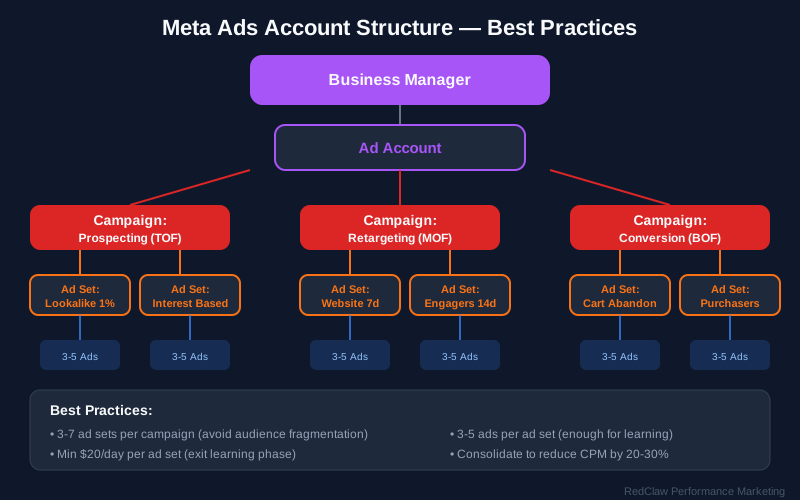
The Simplified Campaign Structure
Recommended Framework:
Business Manager
└── Ad Account
    ├── Campaign: Prospecting (Advantage+ Shopping)
    │   └── Ad Set: Broad + Creative Variations
    ├── Campaign: Retargeting (Website)
    │   ├── Ad Set: Product Viewers
    │   ├── Ad Set: Cart Abandoners
    │   └── Ad Set: Past Purchasers
    ├── Campaign: Retention (Customer List)
    │   └── Ad Set: High LTV Customers
    └── Campaign: Testing
        └── Ad Set: New Creative Concepts
Campaign Level Organization
By Marketing Objective:
| Campaign Type | Objective | Audience |
|---|---|---|
| Prospecting | Sales/Awareness | Cold audiences |
| Retargeting | Sales | Warm audiences |
| Retention | Sales | Past customers |
| Testing | Various | Mixed |
By Funnel Stage:
TOFU (Top of Funnel)
├── Campaign: Awareness - Video Views
├── Campaign: Engagement - Social Proof
└── Campaign: Traffic - Blog Content

MOFU (Middle of Funnel)
├── Campaign: Consideration - Lead Gen
├── Campaign: Evaluation - Product Views
└── Campaign: Comparison - Case Studies

BOFU (Bottom of Funnel)
├── Campaign: Conversion - Sales
├── Campaign: Recovery - Cart Abandon
└── Campaign: Upsell - Premium Products
Ad Set Strategy
2026 Best Practice: Consolidate
Instead of:
Campaign: Sales
├── Ad Set: Women 25-34 - Interest A
├── Ad Set: Women 25-34 - Interest B
├── Ad Set: Women 35-44 - Interest A
└── Ad Set: Women 35-44 - Interest B
Use:
Campaign: Sales
├── Ad Set: Broad - Creative Concept 1
├── Ad Set: Broad - Creative Concept 2
└── Ad Set: Lookalike 1% - All Creative
When to Segment Ad Sets:
- Different budget allocation needs
- Significantly different audiences (B2B vs B2C)
- Geographic separation
- Product category separation
- Testing specific variables
Ad Level Organization
Creative Testing Structure:
Ad Set: Concept A - Problem/Solution
├── Ad 1: UGC Video - Female
├── Ad 2: UGC Video - Male
├── Ad 3: Product Demo - 30s
└── Ad 4: Carousel - Features

Ad Set: Concept B - Social Proof
├── Ad 1: Customer Testimonial
├── Ad 2: Review Compilation
└── Ad 3: Case Study Video
Naming Convention:
[Format]_[Hook]_[CTA]_[Version]

Examples:
- VID_Problem_Purchase_V1
- CAR_Features_LearnMore_V2
- IMG_Offer_ShopNow_Final
Google Ads Account Structure
Account Hierarchy
Google Ads Account
├── Campaign: Brand Search
│   └── Ad Group: Brand Keywords
├── Campaign: Non-Brand Search
│   ├── Ad Group: Product Category A
│   ├── Ad Group: Product Category B
│   └── Ad Group: Product Category C
├── Campaign: Shopping
│   └── Ad Group: All Products
├── Campaign: Display - Remarketing
│   └── Ad Group: Website Visitors
├── Campaign: Performance Max
│   └── Asset Group: All Products
└── Campaign: YouTube
    └── Ad Group: In-Stream Ads
Search Campaign Structure
Brand vs. Non-Brand Separation:
Brand Campaign:
- High intent, low CPA
- Protect brand terms
- Control messaging
- Budget separately
Non-Brand Campaign:
- Discovery and acquisition
- Higher CPA acceptable
- Keyword theme organization
- Test and expand
Ad Group Organization:
Campaign: Non-Brand - Software
├── Ad Group: Project Management Software
│   ├── Keywords: [project management software], "best project management software"
│   └── Ads: PM-specific messaging
├── Ad Group: Task Management Software
│   ├── Keywords: [task management software], "task management tools"
│   └── Ads: Task-focused messaging
└── Ad Group: Team Collaboration Software
    ├── Keywords: [team collaboration software], "collaboration tools"
    └── Ads: Collaboration benefits
Keyword Match Type Strategy:
| Match Type | Use Case | Example |
|---|---|---|
| Exact | High-performers, brand terms | [project management software] |
| Phrase | Core terms with variations | "project management software" |
| Broad Match Modified | Discovery (use cautiously) | +project +management +software |
Shopping Campaign Structure
Standard Shopping:
Campaign: Shopping - Standard
├── Ad Group: Best Sellers
├── Ad Group: High Margin
├── Ad Group: Clearance
└── Ad Group: New Arrivals
Performance Max:
Campaign: Performance Max - Main
└── Asset Group: All Products
    ├── Audience Signals: Customer lists, interests
    ├── Listing Groups: All products or segmented
    ├── Assets: Multiple headlines, descriptions, images
    └── Extensions: Sitelinks, callouts, structured snippets
Display and Video Structure
Remarketing Campaigns:
Campaign: Display - Remarketing
├── Ad Group: All Visitors (30 days)
├── Ad Group: Product Viewers (14 days)
├── Ad Group: Cart Abandoners (7 days)
└── Ad Group: Past Purchasers (90 days)

Campaign: YouTube - Remarketing
├── Ad Group: Video Viewers (30 days)
└── Ad Group: Channel Subscribers
Naming Conventions
Campaign Naming
Format:
[Platform]_[Objective]_[Target]_[Product/Service]_[Date/Version]

Examples:
- FB_Sales_Prospecting_Software_Q1
- GOOG_Search_Brand_AcmeCorp_2026
- FB_LeadGen_Retargeting_Ebook_March
Components:
| Element | Options |
|---|---|
| Platform | FB, IG, GOOG, LI, TW |
| Objective | Awareness, Traffic, Leads, Sales |
| Target | Prospecting, Retargeting, LAL1%, etc. |
| Product | Specific product or category |
| Date | Month, Quarter, or Version |
Ad Set Naming
Format:
[Audience]_[Targeting]_[Bid Strategy]_[Budget]

Examples:
- Broad_25-65_Auto_50
- LAL1_Purchases_CostCap_100
- RT_ProductViewers_Auto_75
Ad Naming
Format:
[Format]_[Creative Concept]_[Version]

Examples:
- VID_Testimonial_V1
- CAR_Features_Final
- IMG_Offer_50Off
Labeling Strategy
Use Labels For:
- Testing status (Testing, Winner, Loser)
- Funnel stage (TOFU, MOFU, BOFU)
- Product category
- Creative theme
- Budget tier
Budget Allocation Strategies
The 70-20-10 Rule
| Allocation | Purpose | Description |
|---|---|---|
| 70% | Proven Winners | Scale what's working |
| 20% | Optimization | Improve existing campaigns |
| 10% | Innovation | Test new approaches |
Funnel-Based Allocation
E-commerce Example:
| Funnel Stage | Budget % | Objective |
|---|---|---|
| Prospecting | 40% | New customer acquisition |
| Retargeting | 35% | Convert warm audiences |
| Retention | 15% | Repeat purchases |
| Testing | 10% | Creative/audience tests |
B2B Example:
| Funnel Stage | Budget % | Objective |
|---|---|---|
| Awareness | 30% | Content promotion |
| Consideration | 35% | Lead generation |
| Decision | 25% | Demo requests |
| Retention | 10% | Customer expansion |
Budget Pacing
Daily vs. Lifetime:
- Daily: Consistent spend, easier control
- Lifetime: Flexible pacing, good for time-sensitive
Shared Budgets:
- Use for campaigns with similar goals
- Allows algorithm to optimize across campaigns
- Best for: Testing campaigns, similar products
Multi-Account Strategies
When to Use Multiple Accounts
Valid Reasons:
- Different business entities
- Geographic separation
- Budget/permission separation
- Agency/client separation
- Testing isolation
Account Structure Example:
Business Portfolio
├── Ad Account: Main Brand
├── Ad Account: Subsidiary A
├── Ad Account: Subsidiary B
├── Ad Account: International
└── Ad Account: Testing/Development
Cross-Account Strategies
Shared Assets:
- Pixels (with proper sharing)
- Audiences (custom audiences)
- Catalogs (for dynamic ads)
- Creative assets
Account Isolation:
- Payment methods
- Campaign data
- Learning signals
- Performance history
Automation and Rules
Automated Rules
Common Use Cases:
| Trigger | Action | Use Case |
|---|---|---|
| CPA > Target | Pause ad | Cut losers quickly |
| ROAS < Target | Reduce budget | Protect profitability |
| Frequency > 3 | Notify | Creative fatigue |
| CTR < 1% | Pause | Poor performance |
| Spend > $X | Increase budget | Scale winners |
Rule Structure:
IF: CPA > $50 (Last 3 days)
AND: Spend > $100
THEN: Pause ad
AND: Send email notification
Campaign Budget Optimization (CBO)
Benefits:
- Automatic budget distribution
- Faster learning
- Simplified management
Best Practices:
- Group similar-performing ad sets
- Minimum $50/day per campaign
- Allow 3-5 days for stabilization
- Monitor for over/under-delivery
Bid Strategies
Meta Ads:
| Strategy | Use Case |
|---|---|
| Lowest Cost | Testing, new campaigns |
| Cost Cap | Controlled CPA |
| Bid Cap | Maximum control |
| ROAS Goal | Profitability focus |
Google Ads:
| Strategy | Use Case |
|---|---|
| Maximize Clicks | Traffic generation |
| Maximize Conversions | Volume focus |
| Target CPA | Cost control |
| Target ROAS | Profitability |
| Maximize Conversion Value | Revenue focus |
Scaling Your Structure
Early Stage (Under $10k/month)
Structure:
- 3-5 campaigns
- Simple naming
- Broad targeting
- Focus on learning
Priorities:
- Establish baseline metrics
- Identify winning creative
- Build initial audiences
- Set up tracking
Growth Stage ($10k-100k/month)
Structure:
- 5-10 campaigns
- Segmented by funnel
- Audience expansion
- Creative testing program
Priorities:
- Scale winning campaigns
- Expand to new audiences
- Increase creative volume
- Implement automation
Scale Stage ($100k+/month)
Structure:
- 10+ campaigns
- Multi-product/catalog
- International expansion
- Advanced automation
Priorities:
- Maintain efficiency at scale
- Sophisticated testing
- Cross-channel coordination
- Team specialization
Conclusion
A well-structured ad account enables efficient management, clear reporting, and scalable growth:
- Keep It Simple: Consolidate when possible
- Name Consistently: Easy identification and reporting
- Segment by Intent: Funnel-based organization
- Automate Wisely: Rules and CBO for efficiency
- Plan for Growth: Structure that scales
The right structure reduces management overhead while improving performance through better data consolidation and algorithmic optimization.
Need help restructuring your ad accounts? RedClaw Performance provides account audits and restructuring services for optimal performance.
Related Posts
iGaming Player Psychology: The Science Behind Why Players Click, Engage, and Convert
Discover the psychological triggers driving iGaming player behavior. Learn how dopamine loops, cognitive biases, and player archetypes influence conversion rates. Data-driven insights for 2026.
Google Ads Account Structure Guide 2026: Optimal Organization for Maximum ROI
Complete Google Ads account structure guide for 2026. Learn optimal campaign organization, keyword grouping, and scalable account architecture for maximum performance and ROI.
Wrong Wallet: How a DeFi Protocol Spent $52K Targeting Web2 Users Who Had Never Touched Crypto
A DeFi lending protocol ran Google Ads targeting 'investment' and 'savings account' keywords, attracting traditional finance users with zero crypto literacy. Conversion rate was 0.12% because the landing page assumed wallet connectivity knowledge.