
advertising
2026 Meta Ads: 5 Trends Reshaping Ad Spend (Andromeda + GEM Model Data)
- RedClaw Marketing
- RedClaw Marketing
- Date
- Reading time
- 20 min read
Facebook & Meta Ads↗ Trends 2026: 7 Shifts Reshaping Ad Spend
Table of Contents
- Year-over-Year: What Changed from 2025 to 2026
- 5 Core Trends + 2 Emerging Opportunities
- Immersive and Interactive Ad Experiences
- Conversational Commerce
- GenAI Creative Tools
- Industry-Specific Trend Analysis
- Cross-Platform Comparison
- 2026 Budget Allocation Recommendations
- Technical Preparation Checklist
- FAQ
The Meta advertising ecosystem is undergoing its most significant transformation since the iOS 14.5 privacy shock of 2021. After years of rebuilding signal loss, investing billions in AI infrastructure, and quietly rolling out automation tools, 2026 is the year everything converges. As reported by Meta Newsroom↗, Meta's $14-15 billion investment in Scale AI, the launch of its Andromeda retrieval algorithm on NVIDIA's GH200 chips, and the global expansion of Threads advertising are reshaping what it means to run ads on the platform.
This is not a speculative wish list. These are trends already in motion, backed by product releases, earnings call commitments, and early adopter data. Whether you manage six-figure monthly budgets or you are just starting your first campaign, understanding these shifts will determine whether you stay ahead or get left behind. If you are new to the platform, our comprehensive Meta Ads guide covers the fundamentals you will need before diving into these advanced trends.
TL;DR — 7 Meta Ads trends reshaping ad spend in 2026:
- AI takes over optimization — Andromeda algorithm is 100x faster; manual bidding is dead
- Short-form video dominates — Reels crossing 50% of all impressions, 20% lower CPMs than Feed
- Privacy-first tracking — CAPI v2 + Privacy Sandbox replaces cookie-based measurement
- Threads goes global — $3-8 CPMs vs $12-18 on Facebook Feed; the arbitrage window is now
- Advantage+ expands beyond e-commerce — Now supports services, SaaS, and subscriptions
- GenAI creative tools mature — AI generates video from images, but authenticity still wins
- Conversational commerce rises — Click-to-Message ads becoming mainstream conversion format Time to read: 20 minutes | Skill level: Intermediate to Advanced | Last updated: March 2026
Want a personalized trend briefing for your vertical? Book a 15-min strategy call — we'll walk you through which 2026 trends impact your campaigns most.
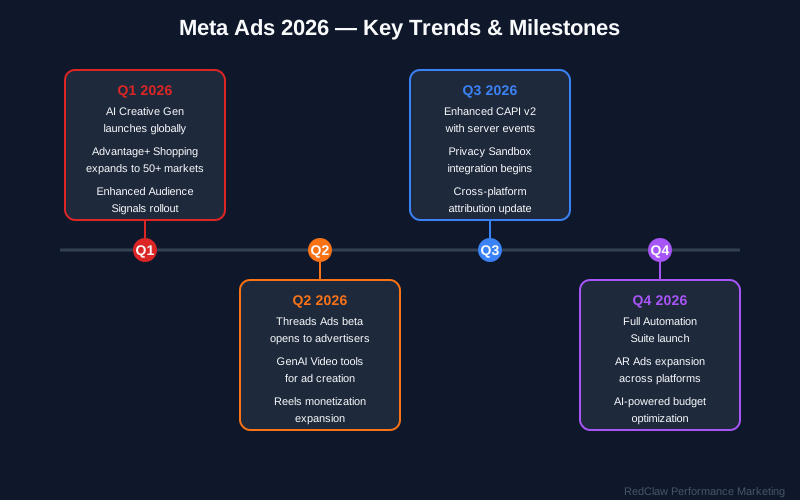
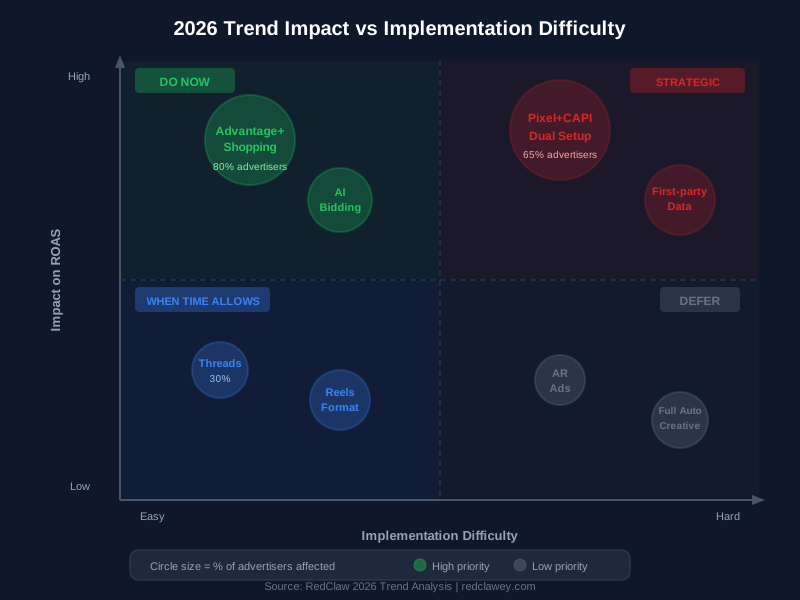
Year-over-Year: What Changed from 2025 to 2026
Before diving into individual trends, here is a high-level comparison of where Meta Ads stood at the start of 2025 versus where the platform is today. This table highlights the magnitude of change across every major dimension of the advertising ecosystem and provides context for why 2026 requires a fundamentally different approach than what worked even 12 months ago.
| Dimension | 2025 Status | 2026 Reality |
|---|---|---|
| Core Strategy | Manual campaign management with AI assistance | AI-first automation with human strategic oversight |
| Creative Format | Static images still dominant, Reels emerging | Short-form video (Reels) accounts for 50%+ of impressions |
| Tracking Infrastructure | Pixel + optional CAPI | Pixel + CAPI mandatory; browser-only tracking loses 40%+ of conversions |
| Audience Targeting | Interest-based targeting still common | Broad targeting + AI optimization is the default best practice |
| New Placements | Threads in limited beta testing | Threads ads available globally, $3-8 CPMs |
| Average CPM (Facebook Feed) | $10-14 | $12-18 (10-20% YoY increase) |
| iOS Impact | ATT opt-in declining, signal loss growing | ATT opt-in stabilized below 25%, CAPI adoption mainstream |
| AI Tools | GenAI in early beta, limited creative generation | Full creative suite: image-to-video, copy generation, format adaptation |
| Biggest Opportunity | Early Advantage+ adoption for e-commerce | Threads placement arbitrage + AI creative scaling |
| Biggest Risk | Signal loss from privacy changes | Creative homogenization as everyone uses the same AI tools |
The data tells a clear story: 2025 was the transition year where AI tools were introduced and privacy infrastructure was built. 2026 is the year where those tools reach maturity and the gap between early adopters and laggards becomes a chasm. Advertisers who invested in CAPI, Advantage+ campaigns, and creative diversification during 2025 are now reaping compounding returns. Those who delayed are facing higher costs and diminishing returns from legacy approaches.
The sections below break down each trend in detail, with specific benchmarks, implementation strategies, and actionable takeaways you can apply immediately.
5 Core Trends + 2 Emerging Opportunities for 2026
Trend 1: AI Takes Over Ad Optimization --- From Assistance to Autonomy
Impact Rating: High | Urgency: Act Now | Budget Impact: +12% ROAS improvement with Advantage+ adoption
In 2025, Meta introduced 11 new AI advertising tools at Cannes Lions and launched its image-to-video conversion tool capable of creating multi-scene video ads from up to 20 product photos. Those were appetizers. In 2026, Meta's stated goal is to "fully automate the process, generating the ad, image, video, and text" --- a vision that CEO Mark Zuckerberg has repeated on multiple earnings calls.
The shift is not incremental. Meta's Andromeda retrieval algorithm is 100x faster at matching users to ads and can process 10,000x more ad variants in parallel than its predecessor. In practical terms, this means the system can test hundreds of creative variations simultaneously and converge on winning combinations within hours rather than days. For advertisers who have spent years manually building audiences and tweaking bids, this represents a fundamental role change: from operator to strategist.
What makes 2026 different from previous "AI will change everything" predictions is that the infrastructure is actually ready. The GH200 chip deployment across Meta's data centers gives the platform the raw compute power to deliver on real-time personalization --- ads automatically adjusted based on user location, device type, time of day, and behavioral patterns --- at a scale that was technically impossible even 18 months ago.
AI Automation Applications:
| Application Area | 2025 Status | 2026 Reality | Impact Level |
|---|---|---|---|
| Audience Targeting | Semi-automated interest settings | Fully automated broad audience via Lattice system | Critical |
| Creative Generation | Basic A/B testing, static variations | AI auto-generates video from images, copy with tone optimization | High |
| Budget Allocation | Rule-based adjustments | Predictive dynamic allocation (8-15% ROAS lift in early tests) | Critical |
| Bidding Strategy | Multiple strategy options | Single AI optimization goal with real-time adjustment | High |
| Placement Selection | Manual or Advantage+ placements | AI-predicted optimal placements across Feed, Reels, Stories, Threads | High |
The performance benchmarks tell the story clearly. Early Advantage+ adopters are seeing e-commerce ROAS climb from 3.2x to 3.6x (a 12% improvement), lead generation CPA drop from $28 to $24 (14% reduction), and app install costs decline from $2.80 to $2.35 per install (16% reduction). These are not theoretical projections --- they are measured results from advertisers already running the updated system.
Advertiser Response Strategies:
- Embrace Broad Audiences: Stop fighting the algorithm. Reduce overly granular audience targeting to give AI more learning space. The best-performing Advantage+ campaigns in 2026 use minimal audience restrictions and let the system find converters.
- Provide Quality Data: AI is only as good as its training signal. Ensure your pixel and Conversions API are correctly configured to feed the system accurate conversion data. A poorly implemented CAPI is worse than no CAPI at all.
- Diversify Creatives at Scale: With AI able to test 25+ creative variations per week (up from 8 in 2025), the bottleneck shifts from testing capacity to creative supply. Prepare diverse visual styles, messaging angles, and format types.
- Set Clear Goals, Then Step Back: Define success metrics precisely so the AI knows exactly what to optimize for. Then resist the urge to micromanage. The advertisers getting the worst results in 2026 are the ones overriding AI decisions based on incomplete data.
Actionable Takeaway: Audit your current campaign structure this week. If you are still running more than 5 ad sets per campaign with narrow audience definitions, consolidate into 1-2 broad Advantage+ campaigns and let the AI do the segmentation. Prepare a creative pipeline that can produce at least 20 unique assets per month.
Let AI handle your bidding — but with expert oversight. We combine AI automation with human strategy to prevent budget waste. Learn about our managed ads service.
Trend 2: Short-Form Video Continues to Dominate --- But the Bar Is Rising
Impact Rating: High | Urgency: Act Now | Budget Impact: -20% CPM by shifting budget to Reels
Reels is no longer the emerging format --- it is the dominant one. With over 200 billion Reels played daily across Facebook and Instagram, Meta has made it clear that vertical video is the centerpiece of its ad delivery system. But 2026 is not just about more Reels. It is about better Reels, and the cost of mediocrity is rising fast.
The data is unambiguous. According to eMarketer's digital advertising analysis↗, Reels ad share is projected to cross 50% of all Meta ad impressions in 2026, up from 35% in 2025. But the more important number is the CPM gap: Reels ads are running 20% lower CPMs than Feed placements, while delivering 40% higher engagement rates. This is the rare arbitrage opportunity in digital advertising, and it will not last forever. As more budget flows into Reels, CPMs will equalize, rewarding early movers who built their creative muscles now.
What is changing in 2026 is the creative standard. When everyone is making Reels, standing out requires more than just shooting vertical. The winning formula combines platform-native aesthetics (think creator-style content, not polished brand videos) with strategic narrative structure. The best-performing Reels ads look like organic content for the first 2 seconds, then seamlessly transition into a product message. This is a craft that takes practice and iteration.
Short-Form Video Performance Projections:
| Metric | 2025 Baseline | 2026 Projection | Change |
|---|---|---|---|
| Reels ad share of impressions | 35% | 50%+ | +15pp |
| Average view-through rate | 25% | 35% | +10pp |
| Short-form CPM vs Feed | Baseline | 20% lower | -20% |
| Engagement rate vs Feed | Baseline | 40% higher | +40% |
The 2026 Short-Form Creative Framework:
The "first 3 seconds" rule has been discussed to death, but few advertisers actually execute it well. Here is the updated structure that top performers are using:
0-1 second:  Pattern interrupt (movement, unexpected visual, direct eye contact)
1-3 seconds: Problem statement or curiosity hook (text overlay, not voiceover)
3-10 seconds: Solution demonstration (show, don't tell)
10-20 seconds: Social proof or deeper explanation
20-30 seconds: Clear CTA with urgency element
The critical insight for 2026 is that 85% of users watch without sound, which means your visual storytelling must carry the entire message independently. Captions are not optional --- they are structural. The brands winning on Reels treat text overlays as a primary communication channel, not an accessibility afterthought. For deeper creative strategy, see our guide on ad creative design principles.
Technical Specifications Update:
- 9:16 vertical format is the absolute standard (no more repurposing horizontal video)
- 4K resolution is gradually becoming the norm as device screens improve
- AI-generated captions with custom styling are replacing manual subtitle burns
- Sound design matters even for muted viewing --- visual rhythm should match an implied beat
Actionable Takeaway: Allocate 45% of your placement budget to Reels in Q2 2026. Build a production workflow that can create 8-10 short-form videos per week, mixing professional shoots with authentic UGC-style content. Test creator-style ads against branded ads --- the performance gap will surprise you.
Trend 3: The Privacy-First Advertising Era --- Conversions API v2 and Privacy Sandbox
Impact Rating: Critical | Urgency: Immediate --- implement CAPI within 30 days | Budget Impact: -25% CPA with proper dual tracking
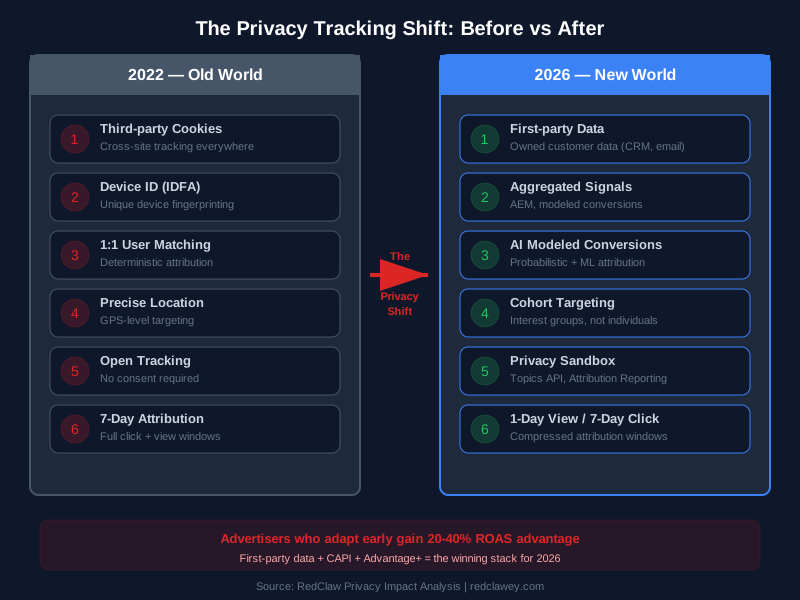
The privacy transformation that began with iOS 14.5 in 2021 has matured from a crisis into a new operating reality. In 2026, the question is no longer "how do we cope with signal loss" but "how do we build a measurement infrastructure that thrives without third-party cookies." The advertisers who treated privacy changes as a temporary inconvenience are now paying the price. Those who invested in first-party data and server-side tracking are seeing returns.
Apple's App Tracking Transparency framework↗ continues to shape the landscape, with opt-in rates now stabilized below 25% globally. The centerpiece of Meta's 2026 privacy strategy is the Conversions API (CAPI), which has evolved from a nice-to-have supplement to an absolute requirement. Browser-based pixel tracking now misses over half of actual conversions due to ad blockers, iOS privacy restrictions, and consent banners. Server-side tracking via CAPI bypasses these limitations entirely by sending conversion data directly from your server to Meta's servers, never touching the browser.
Conversions API v2: What Has Changed
The 2026 iteration of CAPI introduces several critical improvements. Event deduplication has become more intelligent, automatically reconciling server-side and browser-side events without the manual configuration that caused headaches in earlier versions. The new Consent Mode v2 integration allows advertisers to send anonymized, aggregated signals even without explicit user consent (basic mode), while full user data requires explicit opt-in (advanced mode). This is a crucial distinction for advertisers operating in GDPR-regulated markets.
The most significant technical advancement is enhanced event matching. CAPI v2 uses advanced hashing and matching algorithms that improve the event match rate --- the percentage of server events that Meta can associate with a user profile --- from the typical 40-50% range to 65-80% for well-implemented setups. Higher match rates directly translate to better optimization, lower CPAs, and more accurate reporting. If you have not set up dual tracking yet, our pixel and CAPI setup guide walks through the complete implementation.
Privacy Sandbox Integration
Google's Privacy Sandbox initiative is another major factor in 2026. While Chrome's third-party cookie deprecation timeline has shifted multiple times, the direction is clear: cookie-based tracking is ending. Meta has been integrating with Privacy Sandbox APIs, including the Attribution Reporting API and the Topics API, to ensure its ad delivery system can function in a cookieless Chrome environment. For technical details on these APIs, see Google's Privacy Sandbox documentation↗.
Early tests of the Attribution Reporting API show it can recover a very high percentage of conversion signal compared to cookie-based measurement. For Meta advertisers, this means the transition away from cookies should be relatively smooth --- provided you have CAPI properly implemented as your primary measurement backbone. The combination of CAPI server-side data plus Privacy Sandbox browser signals creates a robust, privacy-compliant measurement stack.
Privacy Transformation Impact Matrix:
| Transformation | Impact Scope | 2026 Response Strategy |
|---|---|---|
| Declining ATT opt-in rates (now below 25%) | Severely limited iOS tracking | Server-side CAPI as primary data source |
| Chrome cookie deprecation | Cross-site tracking elimination | Privacy Sandbox API integration + first-party data |
| Shrinking retargeting pools | Smaller custom audiences | Engagement-based audiences + broad AI targeting |
| Rising CPMs (+10-20% YoY) | Increased cost per impression | Creative quality improvement + conversion rate optimization |
| Attribution gaps | Inaccurate ROAS reporting | Multi-touch attribution models + incrementality testing |
First-Party Data Strategy for 2026:
-
Build Owned Data Assets: Add interactive content (quizzes, calculators, assessment tools) to your site. Every interaction is a first-party data point. Optimize newsletter subscription flows and build membership programs that incentivize data sharing.
-
Deep CRM Integration: Regularly upload customer lists to Meta for Custom Audience matching. Build value-based lookalike audiences from your highest-LTV customers. Integrate online conversion data with offline purchase data for a complete customer view.
-
Server-Side Infrastructure: Implement CAPI through a reliable gateway (Meta's own setup, Google Tag Manager server-side, or a dedicated CDP). Monitor event match rates weekly and optimize data parameters to push match rates above 70%. For complete tracking setup guidance, see our GA4 setup guide which covers the analytics foundation you need.
Actionable Takeaway: If you are still running pixel-only tracking, you are flying blind on at least 50% of your conversions. Implement CAPI within the next 30 days. Set a target event match rate of 70%+ and monitor it weekly in Events Manager. Begin building a first-party data strategy that reduces your dependence on any single tracking method.
Worried about iOS tracking gaps? Our Pixel + CAPI dual setup recovers 25-40% of lost conversions. Get a free tracking health check.
Trend 4: Threads Ads Go Global --- The Biggest New Placement Since Stories
Impact Rating: High | Urgency: First-mover window closing in 6-12 months | Budget Impact: -40% CPM vs Facebook Feed at current rates
Meta's Threads platform has crossed 400 million monthly active users, surpassing X (formerly Twitter) in daily mobile usage globally. In January 2026, Meta began rolling out advertising on Threads to all users worldwide, making it the most significant new ad placement since Instagram Stories launched ads in 2017. For the latest Threads product updates, follow the official Threads blog on Meta Newsroom↗.
This is not a small beta test. Threads ads are available to all Meta advertisers through Ads Manager, supporting image, video, and carousel formats. Advertisers can add Threads as a placement to both Advantage+ and manual campaigns, meaning the barrier to entry is essentially zero --- if you are already running Meta ads, you can opt into Threads with a checkbox.
The early economics are compelling. CPMs on Threads are ranging from $3 to $8, with CPCs between $0.30 and $1.50. Compare this to Facebook Feed CPMs averaging $12-18 and Instagram Feed at $10-15, and you see why early adopters are aggressively shifting budget. Like every new placement in Meta's history, these favorable economics will not last. The arbitrage window is open now but will close as more advertisers pile in over the next 6-12 months.
What Makes Threads Different as an Ad Placement
Threads users skew toward text-based engagement and real-time conversation, which means the creative approach must differ from Instagram or Facebook. The most effective Threads ads in early testing are conversational in tone, opinion-driven, and feel like organic posts rather than traditional advertisements. Think tweet-style copy with a provocative take, paired with a clean image or short video clip. Hard-sell creative that works on Facebook Feed tends to underperform on Threads because the platform culture rewards authenticity and intellectual engagement.
The targeting capabilities mirror Meta's broader ecosystem, which is the real advantage over advertising on standalone text platforms. You get the full power of Meta's audience graph --- behavioral targeting, lookalike audiences, retargeting --- applied to a fresh, low-competition inventory pool. This combination of sophisticated targeting and cheap impressions is the textbook definition of a media buying opportunity.
Threads Ads Early Benchmarks:
| Metric | Threads (Q1 2026) | Facebook Feed | Instagram Feed |
|---|---|---|---|
| CPM | $3 - $8 | $12 - $18 | $10 - $15 |
| CPC | $0.30 - $1.50 | $0.80 - $2.50 | $0.70 - $2.00 |
| Engagement Rate | High (novelty factor) | Mature, stable | Moderate |
| Competition Level | Low | Very High | High |
Actionable Takeaway: Add Threads as a placement to your existing campaigns immediately. Create 3-5 text-first ad variations that match the conversational tone of the platform. Allocate 5-10% of your Meta budget specifically to Threads for Q2 2026, and increase based on performance. Monitor CPM trends monthly --- when Threads CPMs approach Instagram levels, the arbitrage is over.
Trend 5: Advantage+ Shopping Expands Beyond E-commerce
Impact Rating: High | Urgency: Test in Q2 2026 | Budget Impact: -14% CPA for lead gen, -16% CPI for app installs
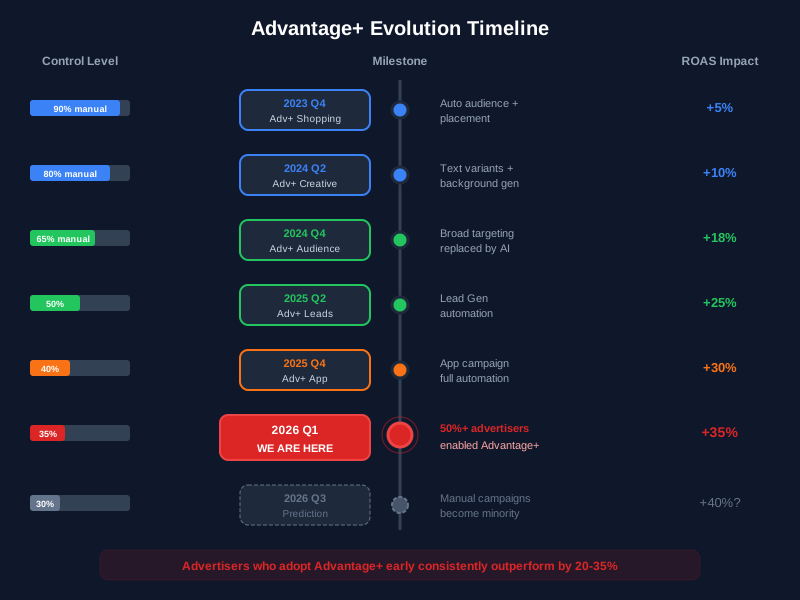
Advantage+ Shopping (now officially renamed Advantage+ Sales, as detailed in Meta's Advantage+ product updates↗) has undergone its most significant expansion in 2026, and the changes extend far beyond e-commerce. Meta has removed the one-ad-set limitation, allowing campaigns to include multiple ad sets with up to 50 ads each. More importantly, Advantage+ now supports services, digital products, and subscription businesses --- opening the platform to SaaS companies, course creators, and service providers who were previously locked out.
The conversion threshold reduction is the change that matters most for small and mid-size advertisers. The original Advantage+ required 50+ weekly conversions for stable AI optimization, effectively excluding businesses with lower volume. In 2026, Shopping campaigns need only 25 weekly conversions, and App campaigns need just 15. This democratization of AI-powered advertising means a local service business generating 4 leads per day can now access the same optimization technology as a global e-commerce brand.
Predictive Budget Allocation is another game-changer. Instead of spreading spend evenly across the day, the system analyzes historical patterns, seasonal trends, and real-time signals to front-load budget during high-conversion windows. Early tests show 8-15% ROAS improvement from this feature alone, with no additional effort from the advertiser. Combined with automatic creative format adaptation across Stories, Reels, and Feed, Advantage+ in 2026 is approaching the point where campaign management is truly set-and-optimize rather than set-and-monitor.
Multi-Market Optimization now allows single campaigns to optimize across similar markets with automatic localization, while inventory-aware delivery integrates with product catalogs to avoid promoting out-of-stock items. For international advertisers, this means one campaign can serve localized creative across 50+ markets without manual duplication.
Actionable Takeaway: If you dismissed Advantage+ Shopping in 2025 because your conversion volume was too low, revisit it now. The 25-conversion-per-week threshold makes it accessible to most active advertisers. Start with a single Advantage+ Sales campaign alongside your existing manual campaigns and compare performance over 2-3 weeks. For product catalog advertisers, enable inventory-aware delivery immediately to stop wasting budget on out-of-stock items.
Already using Advantage+? We've helped 30+ e-commerce brands transition from manual campaigns to Advantage+ with an average ROAS lift of 35%. See our Advantage+ case studies.
Immersive and Interactive Ad Experiences
Impact Rating: Medium | Urgency: Experiment in H2 2026 | Budget Impact: 25-40% lift in purchase confidence for supported categories
AR (Augmented Reality) and interactive ad formats are transitioning from experimental to mainstream in 2026. Meta's continued investment in its Reality Labs division is trickling down into practical advertising applications. AR try-on ads for beauty, eyewear, and furniture brands are showing measurable lift in purchase confidence and meaningful reductions in return rates.
Emerging Ad Formats:
| Format | Primary Use Cases | Expected Impact |
|---|---|---|
| AR Try-On Ads | Beauty, furniture, eyewear, fashion | 25-40% increase in purchase confidence |
| Interactive Carousels | Product showcases, tutorials, storytelling | 2-3x increase in dwell time |
| Playable Ads | Games, app promotion, product demos | 30% improvement in install quality |
| 3D Product Showcases | E-commerce, luxury goods, real estate | 15-25% reduction in return rates |
While these formats require higher production investment, the performance data increasingly justifies the cost. Brands that adopt AR and interactive formats in 2026 will build a competitive moat that is difficult to replicate quickly.
Conversational Commerce: Messenger, WhatsApp, and Instagram Direct
Impact Rating: Medium-High | Urgency: Set up basic automation in Q2 2026 | Budget Impact: -30% cost per qualified lead for service businesses
Click-to-Message ads are becoming a mainstream conversion format in 2026, not just for lead generation but for complete purchase journeys. Meta's AI chatbot capabilities have advanced to the point where automated conversations can handle product recommendations, FAQ responses, appointment booking, and even checkout --- all within the messaging thread.
Conversational Ad Evolution:
| Feature | 2025 | 2026 Reality |
|---|---|---|
| Click-to-Message ads | Emerging format | Mainstream, ~10% of ad spend |
| AI chatbots | Basic keyword responses | Intelligent sales assistants with product knowledge |
| Auto-booking | Simple link-outs | Full calendar integration within chat |
| In-chat purchase | Partial, clunky | Seamless payment and checkout |
For service businesses and high-consideration purchases, conversational ads often outperform landing page funnels because they reduce friction and build trust through dialogue. The key is designing automation flows that feel helpful rather than robotic, with clear escalation paths to human agents for complex queries.
Actionable Takeaway: Set up a basic Messenger automation flow with welcome messages, top-5 FAQ responses, and a booking or inquiry form. Test Click-to-Message ads with a small budget alongside your standard traffic campaigns. Measure conversation initiation rate, response rate, and conversation-to-conversion rate as your primary KPIs.
GenAI Creative Tools: Capabilities and Limitations
Meta's generative AI creative tools deserve a dedicated discussion because they represent both the biggest opportunity and the biggest risk in 2026 advertising. The Advantage+ Creative suite, powered by Meta's AI research↗, can now generate video from static images, create headline and copy variations with tone optimization, and adapt formats automatically across Stories, Reels, and Feed. Creative production costs are dropping by up to 40% for advertisers who fully adopt these tools.
Practical Application Scenarios:
- E-commerce product ads: Upload 10-20 product photos and the AI generates multi-scene video ads with transitions, text overlays, and music. This works well for product demonstrations and catalog-style advertising.
- Dynamic copy testing: Write one headline and the AI generates 10-15 variations with different emotional appeals, urgency levels, and benefit framings. The system then tests all variations and converges on winners.
- Format adaptation: Create one square image ad and the AI automatically generates 9:16 Reels versions, Stories versions, and Threads-optimized versions with appropriate cropping, text placement, and pacing adjustments.
Where GenAI Creative Falls Short:
Despite the hype, there are real limitations that experienced advertisers should understand. AI-generated creative tends to converge on similar aesthetics, which means as more brands adopt the tools, ads start looking interchangeable. The irony of 2026 is that authenticity --- real imagery, genuine customer testimonials, creator-style content shot on smartphones --- stands out more than ever against a sea of AI-polished visuals.
AI also struggles with brand nuance. It can generate technically competent creative, but it cannot replicate the strategic insight of understanding why a particular message resonates with a specific audience segment. The winning approach in 2026 is hybrid: use AI for production efficiency (format adaptation, copy variation, basic video generation) while keeping human strategists in control of creative direction, brand voice, and campaign narrative.
Actionable Takeaway: Start using Advantage+ Creative for format adaptation and copy variation --- these are high-value, low-risk applications. Reserve AI video generation for catalog and product ads where visual storytelling is straightforward. For brand campaigns and emotional storytelling, keep human creative direction at the center. Read our ad creative design principles guide for the strategic framework that AI cannot replace.
📊 Try it yourself: Use our free Budget Planner to model your 2026 Meta Ads budget allocation across Reels, Threads, and Feed placements based on the benchmarks in this article.
Industry-Specific Trend Analysis
iGaming: Navigating Compliance While Scaling Performance
iGaming is RedClaw's core client vertical, and the Meta Ads landscape for gambling and online gaming advertisers is both more challenging and more rewarding in 2026 than ever before. The regulatory environment continues to tighten --- Meta now places full compliance responsibility on advertisers rather than relying on country-level whitelisting. In the United States, online gambling ads are restricted to states where online gambling is legal, requiring valid state licenses and age-targeting restrictions of 21+.
But regulatory complexity creates competitive moats. Advertisers who master compliance can access inventory that less sophisticated competitors cannot. The key changes for iGaming in 2026 include mandatory responsible gambling messaging in all creative (helpline numbers, support organization links), enhanced age verification and geo-targeting requirements, and AI-powered compliance screening that automatically reviews ad creative before submission.
The creative strategy for iGaming on Meta in 2026 leans heavily into entertainment value and community --- showcasing the social experience rather than financial outcomes. AI-generated personalized creative is becoming standard in the industry, with ads tailored to user preferences in real time. However, the compliance overlay means every creative variation must pass regulatory review, which adds production complexity.
For iGaming operators, understanding Meta's compliance framework is not optional --- it is the prerequisite for advertising at all. The operators seeing the best results in 2026 combine automated compliance checking with creative strategies that emphasize entertainment, community, and responsible play.
Actionable Takeaway: Build a compliance-first creative workflow where every ad variation is reviewed against Meta's current iGaming policies before submission. Invest in geo-targeting infrastructure that ensures ads only serve in legally permitted markets. Test entertainment-focused creative angles that highlight social features and gaming experiences rather than monetary outcomes. Check our iGaming Meta Ads benchmarks for latest CPA and ROAS data by region, and learn from real creative fatigue case studies to avoid common pitfalls.
SaaS and Subscription Businesses
The Advantage+ expansion to digital products and services is a watershed moment for SaaS advertisers on Meta. Previously, Meta's AI optimization was tuned for e-commerce purchase patterns --- fast decision cycles, visual product evaluation, impulse buying. SaaS has fundamentally different dynamics: longer consideration periods, trial-to-paid conversion funnels, and value propositions that are harder to communicate visually.
In 2026, Advantage+ now understands subscription renewal patterns, trial conversion rates, and multi-step funnel optimization. SaaS advertisers can set up event sequences (free trial signup, product activation, paid conversion) and let the AI optimize for the full funnel rather than just the top-of-funnel lead.
The creative challenge for SaaS on Meta remains significant. The most effective approach combines educational short-form video (showing the product solving a real problem in under 30 seconds) with retargeting campaigns that address specific objections. Webinar and demo registration ads continue to perform well when paired with strong social proof --- customer logos, usage statistics, and ROI testimonials.
Actionable Takeaway: Set up a multi-step conversion event sequence in Events Manager: trial signup, activation milestone, paid conversion. Use Advantage+ Sales with this event chain and let the AI optimize for downstream value, not just lead volume. Produce 5-10 product demo Reels showing specific use cases in under 30 seconds each.
Lead Generation & Professional Services
The Advantage+ expansion beyond e-commerce is transforming how professional service businesses use Meta Ads. Lawyers, accountants, consultants, agencies, and B2B service providers have historically struggled with Meta's optimization algorithms because their conversion volumes are lower and sales cycles are longer than e-commerce. In 2026, the reduced conversion thresholds (25 weekly events for Shopping, down from 50) combined with multi-step funnel optimization make Meta a viable performance channel for services for the first time.
The winning formula for lead generation in 2026 combines Click-to-Message ads with AI-powered chatbot qualification. Instead of sending cold traffic to a landing page with a form (which converts at 2-5% for most service businesses), Click-to-Messenger or Click-to-WhatsApp ads initiate a conversation where an AI chatbot qualifies the lead, answers initial questions, and books a consultation --- all within the messaging thread. Early adopters are reporting 30-40% lower cost per qualified lead compared to traditional landing page funnels.
For professional services, creative strategy should emphasize expertise and trust signals. Case studies presented as short-form video testimonials, data-driven carousel ads showing client results, and educational content that demonstrates domain authority consistently outperform generic promotional creative. The key is positioning ads as valuable content rather than sales pitches --- the conversion happens in the follow-up conversation, not the initial click.
Actionable Takeaway: Set up a Messenger or WhatsApp automation flow with qualification questions, FAQ responses, and calendar booking integration. Test Click-to-Message ads at 20-30% of your Meta budget alongside traditional landing page campaigns and compare cost per qualified lead over 30 days.
Local Businesses & Brick-and-Mortar
Local businesses have a unique advantage on Meta in 2026: the combination of hyperlocal targeting, store visit optimization, and conversational commerce creates a direct line from digital ad to physical foot traffic. Meta's store visit optimization objective has matured significantly, using location signals, WiFi data, and user behavior patterns to identify users most likely to visit a physical location after seeing an ad.
The most effective local business strategy pairs hyperlocal Reels ads (showing the physical location, staff, and customer experience) with offer-driven retargeting to users within a defined radius. A restaurant showing a 15-second Reel of a chef preparing a signature dish, targeted to users within 10 miles, followed by a retargeting ad with a first-visit discount, is the blueprint that consistently delivers results.
For multi-location businesses, Advantage+ now supports location-aware dynamic creative that automatically shows the nearest store address, hours, and directions based on the user's location. This eliminates the need to create separate campaigns for each location and lets the AI handle geographic optimization.
Actionable Takeaway: Create 3-5 location-specific Reels showing your business personality. Target a 15-mile radius with store visit optimization. Add a Click-to-Message CTA for reservations or inquiries. Budget $15-30/day per location as a starting point.
Finance, Insurance & Crypto
Financial services advertising on Meta operates under strict regulatory constraints, but the advertisers who master compliance gain access to a massive, engaged audience with high lifetime value. In 2026, Meta has streamlined its approval process for licensed financial service providers while tightening enforcement against unlicensed operators, creating a cleaner competitive environment for legitimate businesses.
For traditional finance and insurance, the privacy-first tracking trend is especially impactful. Financial customers are privacy-conscious, and ATT opt-in rates in the finance vertical are among the lowest across industries (estimated 15-20%). This makes CAPI implementation not just recommended but essential --- without server-side tracking, financial advertisers may be blind to 50%+ of their conversions. The brands winning in this space combine robust CAPI infrastructure with value-based optimization that prioritizes high-premium or high-deposit customers over raw lead volume.
Cryptocurrency advertising on Meta has evolved from near-total prohibition to a regulated framework. Licensed cryptocurrency exchanges and wallet providers can now advertise with prior written authorization from Meta. The creative restrictions are significant --- no promises of returns, no celebrity endorsements for financial products, no misleading yield claims --- but the reduced competition (most crypto projects cannot meet the licensing requirements) means lower CPMs and less auction competition for compliant advertisers. NFT and DeFi protocol advertising remains prohibited in most markets, though this may evolve as regulatory frameworks mature.
Actionable Takeaway: Apply for Meta's financial services advertiser authorization if you have not already. Implement CAPI as a priority --- the signal loss in finance is higher than average verticals. Build creative around education and trust (market insights, planning tools, customer testimonials) rather than promotional offers. For crypto, ensure your licensing documentation is current and your creative passes Meta's regulatory pre-screen before scaling spend.
E-commerce: Dynamic Catalog and Live Shopping
E-commerce remains Meta's strongest vertical, but the competitive landscape is fierce. The 2026 differentiators are AI-optimized dynamic product recommendations, inventory-aware delivery that prevents wasted spend on out-of-stock items, and the emerging integration of live shopping with advertising.
AR try-on ads are reaching maturity for beauty, eyewear, and furniture categories, with measurable reductions in return rates (15-25%) and increases in purchase confidence. For catalog-heavy retailers, the combination of Advantage+ Shopping with complete product feeds, high-quality imagery, and CAPI-powered conversion tracking is the formula for sustainable ROAS.
Actionable Takeaway: Complete your product catalog with high-resolution images, accurate pricing, and availability data. Enable inventory-aware delivery to stop promoting out-of-stock items. Test AR try-on if your product category supports it --- the ROI data is now strong enough to justify the production investment.
Cross-Platform Comparison: Meta vs Google Ads↗ vs TikTok Ads↗
No 2026 advertising strategy exists in a vacuum. With global social media ad spending projected to surpass $276 billion according to Statista's digital advertising outlook↗, understanding how Meta's evolution compares to its primary competitors helps you allocate budget intelligently across platforms.
Meta vs Google Ads: Google's Performance Max offers partial automation but still requires more manual asset creation than Meta's fully generative approach. Google's strength remains intent-based search advertising, which Meta cannot replicate. The best strategy uses Google for high-intent capture (search, shopping) and Meta for demand generation and audience building. In 2026, Meta's advantage in creative automation and social proof (comments, shares, reactions visible on ads) gives it an edge for brand building and top-of-funnel awareness.
Meta vs TikTok Ads: TikTok's Smart+ campaigns still require human-created video assets, while Meta's AI can generate video from static images. However, TikTok maintains an edge in reaching Gen Z audiences and in trend-driven creative that feels native to the platform. The CPM gap is narrowing --- TikTok's initial cost advantage has diminished as more advertisers have entered the platform. For most brands, the optimal approach in 2026 is to lead with Meta for broad reach and sophisticated targeting, while using TikTok for younger demographics and culture-driven campaigns.
Platform Comparison Summary:
| Capability | Meta Ads | Google Ads | TikTok Ads |
|---|---|---|---|
| AI creative generation | Full (images, video, copy) | Partial (copy, some image) | Limited (human assets required) |
| Audience targeting depth | Best-in-class (2.9B+ users) | Intent-based (search signals) | Interest-based (growing) |
| New placement opportunity | Threads (low CPM) | None significant | Limited |
| Privacy-first readiness | CAPI v2 + Privacy Sandbox | Enhanced Conversions + Consent Mode | Pixel + Events API |
| E-commerce integration | Advantage+ Shopping + Catalog | Performance Max + Merchant Center | TikTok Shop |
| iGaming support | Compliance framework, restricted | Similar restrictions | Very limited |
Actionable Takeaway: Do not put all your budget on one platform. Use Meta as your primary demand generation engine (50-60% of budget), Google for intent capture (25-35%), and TikTok for audience expansion and trend-driven campaigns (10-20%). Adjust ratios based on your target demographic and vertical. For advanced audience strategy across platforms, review our Meta Ads audience targeting guide. Need help modeling different allocation scenarios? Use our Budget Planner tool and ROAS Calculator to find the optimal split for your business.
2026 Budget Allocation Recommendations
Placement Budget Allocation
| Placement | 2025 Recommendation | 2026 Recommendation | Adjustment Reason |
|---|---|---|---|
| Reels | 30% | 45% | Dominant format, best CPM efficiency |
| Stories | 20% | 15% | Partial shift to Reels, still strong for retargeting |
| Feed | 35% | 20% | Rising costs, declining engagement |
| Threads | 0% | 10% | New placement arbitrage opportunity |
| Messenger | 10% | 5% | Conversational commerce maintains niche value |
| Emerging Formats (AR, Interactive) | 5% | 5% | Experimental investment for future readiness |
Creative Production Budget Allocation
| Item | Budget Share | Notes |
|---|---|---|
| Short-form video production | 45% | Highest priority --- Reels and Stories |
| UGC and creator content | 25% | Authenticity premium in AI-saturated environment |
| Static images and carousels | 15% | Supporting use, catalog ads |
| Interactive/AR content | 10% | Test new formats, build capability |
| AI-generated variations | 5% | Leverage Advantage+ Creative, low marginal cost |
Technical Preparation Checklist
Essential Data Infrastructure
- Meta pixel correctly installed and verified across all conversion pages
- Conversions API v2 setup complete with event match rate above 70%
- Event deduplication configured between pixel and CAPI
- Consent Mode v2 implemented for GDPR compliance
- First-party data collection mechanisms active (newsletter, membership, interactive tools)
- CRM system integrated with Meta Custom Audiences for regular list uploads
- GA4↗ cross-domain tracking verified (setup guide here)
Creative Production Capability
- Short-form video production workflow capable of 8-10 videos per week
- Auto-caption generation tools integrated into editing workflow
- Asset management system for organizing and versioning creative
- A/B testing framework with documented hypothesis and result tracking
- Threads-specific creative templates (text-first, conversational tone)
Automation and Campaign Setup
- Advantage+ Sales campaigns tested alongside manual campaigns
- Predictive Budget Allocation enabled in Advantage+ campaigns
- Threads added as placement in at least one active campaign
- Automation rules configured for budget scaling and pause triggers
- Reporting automation with weekly performance dashboards
Frequently Asked Questions
Q1: Will AI automation replace ad operations personnel?
Not completely, but the role is transforming fundamentally. The tactical skills that defined media buying for the past decade --- manual bid adjustments, audience segment building, daily metric monitoring --- are being absorbed by AI. What remains and grows in value is strategic thinking: understanding business objectives, directing creative vision, interpreting AI decisions, and making cross-channel allocation choices that require human judgment.
| Declining Skills | Rising Skills |
|---|---|
| Manual bid adjustments | Strategic goal-setting and business alignment |
| Building audience segments | Creative direction and brand storytelling |
| Daily metric monitoring | Insight interpretation and anomaly detection |
| Report creation and formatting | Cross-channel strategy and budget allocation |
The media buyers who thrive in 2026 are those who have shifted from operators to strategists, spending less time in Ads Manager and more time understanding their customers, their competitors, and their creative pipeline.
Q2: Will privacy policies make advertising permanently more expensive?
Short-term cost increases of 10-20% in CPMs are real and ongoing. But the long-term picture is more nuanced. AI optimization improvements are gradually offsetting signal loss, and advertisers with strong first-party data strategies are seeing CPAs stabilize or even decrease. The advertisers paying the highest costs in 2026 are those who never invested in CAPI, have thin first-party data, and rely on shrinking retargeting audiences. The key lever is not fighting rising CPMs but improving creative quality and conversion rates to maintain or improve ROAS despite higher impression costs.
Q3: How should small businesses respond to these trends?
Priority Order:
- Short-form content first (smartphone shooting is fine --- authenticity outperforms production value)
- CAPI implementation (even basic setups dramatically improve tracking accuracy)
- Advantage+ adoption (the lowered conversion thresholds make AI optimization accessible)
- First-party data collection (email newsletters, loyalty programs, interactive content)
- Threads placement testing (free to add, potential CPM savings)
Small businesses actually have an advantage in 2026: the AI levels the playing field on optimization, and authentic, scrappy content often outperforms polished corporate creative on Reels and Threads.
Q4: Is it too early to invest in Threads advertising?
No. The global rollout is live, the ad formats are mature (image, video, carousel), and the CPMs are at their lowest point. Every new Meta placement follows the same pattern: early adopters get cheap inventory, CPMs rise as competition increases, and latecomers pay premium prices. The risk of testing Threads now is minimal (5-10% budget allocation), while the cost of waiting is permanently higher CPMs.
Q5: What is the best bidding strategy for Meta Ads in 2026?
For most advertisers, "Maximize Conversions" with a cost-per-result goal (target CPA) is the recommended starting point. This gives the AI a clear optimization target while providing a cost guardrail. Once you have accumulated 100+ conversions and have stable performance data, switch to "Maximize Conversion Value" with a ROAS goal to optimize for revenue rather than volume. Avoid "Lowest Cost" bidding without a cap, as it tends to overspend during high-competition periods without regard for efficiency. The one exception is during new campaign launches: use "Lowest Cost" for the first 7 days to help the algorithm exit the learning phase faster, then switch to target CPA or target ROAS once you have baseline data.
Q6: Are Facebook Ads still worth it in 2026, or should I move budget elsewhere?
Facebook Ads (as part of the broader Meta Ads ecosystem) remain the single most effective demand generation platform for the majority of businesses in 2026. The platform's 3.1 billion monthly active users, unmatched behavioral targeting, and increasingly sophisticated AI optimization create a combination that no competitor fully replicates. However, "Facebook Ads" now means much more than the Facebook News Feed --- it includes Instagram, Reels, Stories, Messenger, Audience Network, and Threads. The advertisers who struggle with Meta in 2026 are typically those still running Feed-only campaigns with static images and narrow targeting from the 2020 playbook. If you modernize your approach (Reels-first creative, broad targeting, Advantage+ campaigns, CAPI tracking), Meta delivers strong ROAS across virtually every vertical.
Q7: How do Threads Ads compare to Instagram Ads in terms of performance?
Threads Ads currently offer significantly lower CPMs ($3-8) compared to Instagram Feed ($10-15) and Instagram Stories ($8-12), but the comparison is nuanced. Threads excels at text-driven engagement and conversational brand building, while Instagram remains stronger for visual product discovery and shopping. Click-through rates on Threads tend to be higher due to lower competition and novelty, but conversion rates may be lower because the platform's user behavior is more browsing-oriented than purchase-oriented. The recommended approach is to use both: Instagram for product-focused conversion campaigns and Threads for awareness, engagement, and brand positioning at lower CPMs. As Threads matures as an advertising platform↗, expect performance metrics to converge with Instagram over the next 12-18 months.
Q8: What budget should I allocate to Advantage+ Shopping campaigns?
Start by running Advantage+ Shopping alongside your existing manual campaigns at 30-40% of your total Meta budget. Do not migrate everything at once. After 2-3 weeks of parallel testing, compare ROAS, CPA, and new customer acquisition rates between Advantage+ and manual campaigns. Most advertisers find Advantage+ outperforms within the first month, at which point you can gradually shift to 50-60% Advantage+ allocation. Keep 20-30% of budget in manual campaigns for specific strategic needs (seasonal promotions, specific audience testing, regulated content). The minimum recommended Advantage+ budget is $100/day to ensure the AI has sufficient data for optimization.
Q9: How will cookie deprecation affect my Meta Ads campaigns?
Google's planned deprecation of third-party cookies in Chrome will reduce cross-site tracking capabilities, but the impact on Meta Ads will be less severe than many fear --- provided you have already implemented CAPI. Meta has been integrating with Google's Privacy Sandbox APIs↗ since 2024, including the Attribution Reporting API and Topics API, to maintain ad delivery and measurement in a cookieless environment. Early tests show these APIs recover a high percentage of conversion signal. The advertisers most affected will be those still relying solely on the Meta Pixel without CAPI, as browser-side tracking will lose additional signal. The practical action is straightforward: implement CAPI now if you have not already, build first-party data assets (email lists, membership programs), and ensure your Consent Mode v2 implementation is complete for GDPR compliance.
Q10: How should I prepare my team for AI-driven advertising automation?
The transition to AI-driven advertising requires a fundamental skills shift. Tactical execution skills (manual bid management, audience segment building, daily report pulling) are being automated. Strategic skills are becoming more valuable: creative direction, brand storytelling, business strategy alignment, and data interpretation. Invest in training your team on creative production workflows, data analysis beyond surface metrics, and cross-channel strategy development. The most successful teams in 2026 operate with a "strategist + AI" model where humans define objectives, set creative direction, and interpret results while AI handles campaign optimization, audience discovery, and budget allocation. Consider sending team members to Meta's Blueprint certification program↗ which has been updated for 2026 to reflect AI-first campaign management.
Conclusion: Preparing for a Year of Convergence
2026 is not a year of one big change --- it is the year where AI automation, privacy infrastructure, new placements, and creative tools all reach maturity simultaneously. The advertisers who succeed will be those who treat these trends as interconnected rather than isolated.
Strong CAPI implementation feeds better data to AI optimization. Better AI optimization makes Advantage+ campaigns more effective. Effective Advantage+ campaigns free up human attention for creative strategy. Better creative strategy produces the authentic, engaging content that wins on Reels and Threads. Each element reinforces the others.
The biggest mistake you can make in 2026 is inaction. The second biggest mistake is trying to adopt everything at once without a clear priority framework. Start with data infrastructure (CAPI, first-party data), then optimize campaign structure (Advantage+, Threads placement), then invest in creative capability (Reels production, GenAI tools). Build sequentially, measure rigorously, and adapt continuously.
Immediate Action Plan
This Week:
- Add Threads as a placement in your top-performing campaign
- Verify CAPI event match rate in Events Manager (target: 70%+)
- Audit Reels budget allocation against the 45% benchmark
This Month:
- Launch one Advantage+ Sales campaign alongside existing manual campaigns
- Build a short-form video production pipeline (target: 8+ videos/month)
- Implement first-party data collection on your highest-traffic pages
This Quarter:
- Shift budget allocation to match 2026 placement recommendations
- Test GenAI creative tools for format adaptation and copy variation
- Build a cross-platform strategy incorporating Meta, Google, and TikTok
💡 Need help implementing these trends for your business? RedClaw's performance marketing team specializes in Meta Ads strategy, CAPI implementation, and creative production for high-growth brands. From iGaming compliance to e-commerce scaling, we build data-driven campaigns that turn these industry trends into measurable results. Get in touch → to discuss your 2026 advertising strategy.
Last Updated: March 31, 2026 | Created by RedClaw Marketing Team. Please cite source when sharing.
Related Posts
- advertisingChatGPT Ads vs Meta vs Google: How They Differ and How to Split BudgetChatGPT ads act like a search ad, not a Meta replacement. Trigger, inventory, ban risk and access compared, plus a Meta-base, ChatGPT-position, GEO split.
- advertisingGEO Agency Services: How to Choose a Generative Engine Optimization ProviderChoosing a GEO agency comes down to whether they can prove mention rate, whether content is truly AI-liftable, and what the price includes. Here are 5 evaluation standards and a pre-contract checklist to avoid providers who rebadge SEO as GEO.
- advertisingHow to Get ChatGPT to Recommend Your Brand: 5 GEO StepsGetting ChatGPT to recommend you is GEO, not luck. Five steps: pin core questions, write liftable self-contained passages, build verifiable authority signals, cover conversational long-tail, and monitor mention rate. Plus an AI-citability checklist.