
iGaming User Acquisition: 8 Strategies to Acquire High-LTV Players
- Nadica Metuleva (Blockchain-Ads)
- Nadica Metuleva (Blockchain-Ads)
- Date
- Reading time
- 8 min read
Guest post by Nadica Metuleva, Senior Content Writer at Blockchain-Ads↗.
TL;DR: A first deposit tells you little about player value. Agree a contribution-after-costs definition with finance, track every step from ad to repeat deposit before launch, then judge each source, affiliate and market on what its players contribute months later, not on how many first deposits it brings in. In Blockchain-Ads' 2026 sample, advertisers with tracking in place before launch recorded a first conversion 46% of the time, against 24% for those who added it later.
One campaign can bring in hundreds of first-time depositors, but still struggle to pay for itself.
Why is this, you wonder?
Even if a campaign looks like a success based on the numbers, bringing in one-time depositors is not the goal here. Many players leave after they use the welcome offer. Others cost more in bonuses and acquisition fees than they will ever contribute to the brand.
Yes, a first deposit looks good on your dashboard, but it actually tells you very little about what happens next. This is the main problem with judging iGaming user acquisition too early. If you want the players who contribute actual, sustainable value, you need to connect the acquisition decisions to what those people will do after they join.
With that in mind, here is how you can build that connection and acquire high-LTV iGaming users.
Step 1: Define the Player Value You Want to Acquire
Before you go ahead and change your targeting, you need to decide on what "high-LTV" means for your operation.
Remember: deposits aren't revenue. Gross gaming revenue won't tell you what remains after the bonuses, taxes, the payment fees, and other costs. You need to choose a value definition with finance, one that is consistent, then use it across your acquisition reporting.
One good starting point for this is projected player contribution before acquisition costs. Compare this estimate with customer acquisition separately. This should show you whether a cohort is likely to repay the investment you made on the acquisition.
You can use fixed reporting windows, too.
Think of it this way.
Compare one channel's seven-day results with another's three-month results. If you do this, the older one will look better, but that's simply because it had longer to mature.
Let's see what this would look like in practice:
| Acquisition source | Cost per acquired player | Projected contribution before acquisition cost | Contribution after acquisition cost |
|---|---|---|---|
| Source X | $80 | $110 | $30 |
| Source Y | $130 | $220 | $90 |
As you can see here, Source Y costs more upfront, but it leaves you with more contribution. Of course, these are just invented figures to show you the calculation, and should not be considered industry benchmarks. For real channel-level cost ranges, see our iGaming ROAS benchmarks for 2026.
Step 2: Track the Journey before You Spend on Traffic
If the connection disappears at registration, you can't connect the player lifetime value to the ad.
How do you fix this?
Set up the measurement chain before the actual launch. We are talking about campaign source, registration, verification, first deposit, and ultimately, all subsequent contributions. Whenever you can, connect the advertising events with your player database and CRM, but make sure this is permitted.
The State of Advertising in Crypto, iGaming and Finance 2026 report by Blockchain-Ads puts this plainly:
"Install conversion tracking before the first ad set spends anything."
Its sample covered over 200 advertisers across crypto, iGaming and finance, approximately 1,400 ad sets and 1.4 billion impressions. The advertisers with tracking installed before launch recorded a first deposit, purchase or trade at a rate of 46%, all this compared with 24% among those who added it later.
Of course, this isn't proof that installing tracking will increase player LTV. It is simply a set of recorded outcomes across three industries. However, better measurement can often reveal conversions that you might not have recorded otherwise.
Expert tip: Try to test the full journey yourself. Check which events arrive once, carry the correct values, and keep track of players who move between devices.
Step 3: Look Beyond the First Deposit
Getting a customer to deposit once doesn't tell you whether they will stick around. That's where iGaming player retention comes in. You need to know how many of the new depositors return after the welcome offer is gone.
Do they return after the welcome offer ends?
Once you account for bonuses and other expenses, was acquiring them actually worth it?
Start with players who joined a few months ago. Now, compare the ones who stuck around with the ones who left. Then, look for early differences that can help you judge new traffic.
You might find that an affiliate brings plenty of first depositors, but very few players actually return.
Another source might cost more per depositor, but it brings customers who contribute more after costs.
This is a reason to reconsider where you will invest next month's budget.
Finally, check whether these patterns hold across several groups.
Step 4: Use What You Already Know about the Players
Let's now take a look at the players who stayed with you after the welcome offer.
- Do these players come from particular sources?
- Do they prefer certain games?
- Are the patterns different for casino and sportsbook players?
Gather your customer data. This can help you narrow down who you should reach next. Keep the groups specific: someone who joined for football betting may have little in common with someone who plays live casino games.
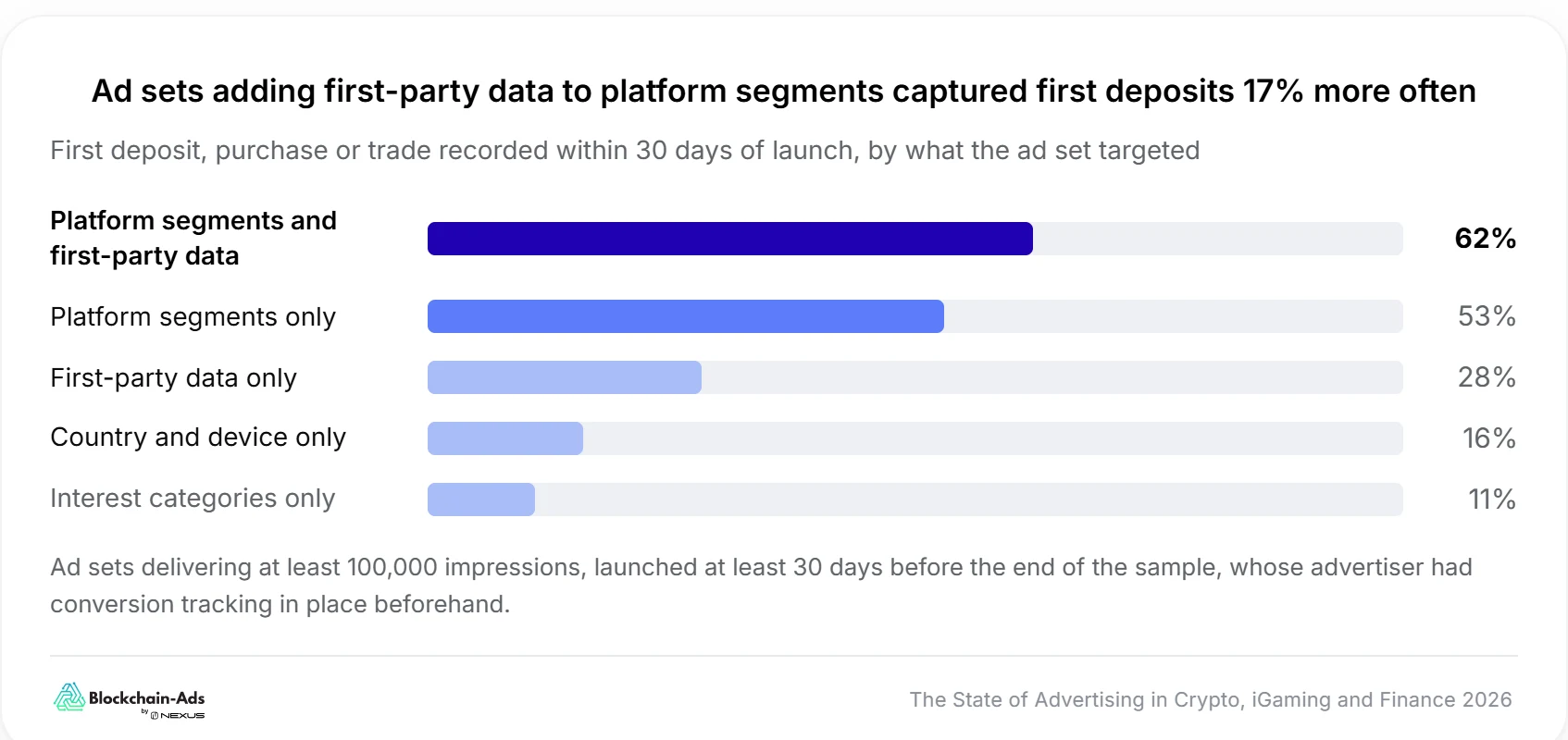
Blockchain-Ads' report found that 62% of ad sets combining platform audiences with advertisers' own data recorded a first deposit, a purchase, or a trade within 30 days, compared with 53% using platform audiences alone.
Source: Blockchain-Ads, The State of Advertising in Crypto, iGaming and Finance 2026.
Keep in mind that these describe how many ad sets recorded a result, rather than how many people converted. Try this combination with your own campaigns, then follow the players it brings in.
Do they stay? Does their value justify the acquisition cost?
Expert tip: Keep the self-excluded customers, restricted accounts, and any flagged accounts out of your targeting lists. In the UK, that includes players registered with the national self-exclusion scheme GAMSTOP↗.
Step 5: Give People a Reason to Join Beyond the Bonus
A welcome bonus is great. It has a proven track record for getting people through the door. But what would make people choose you when almost everyone else is offering something similar?
Try ads that focus on other things your website does well. It could be coverage of a particular league, or something as simple as support in the player's language.
Be specific, and make sure the page they land on backs up the advert.
Expert tip: Leave room in the budget to test different approaches. Give each test enough budget and time to learn something. Keep track of what you changed.
Step 6: Check What Each Affiliate's Players Are Worth
In iGaming affiliate marketing, getting 100 new depositors is only a part of the big picture. When an affiliate sends you 100 new depositors, you need to ask: what happened to them?
- Did they finish verification?
- Were many of them flagged for fraud?
- How many players are still around a month later?
- How much did you spend on bonuses to bring them in?
Compare partners over the same period and look at what remains after expenses. Very often, an affiliate with a higher fee is more worthwhile to you if its players stay longer. Our iGaming affiliate ROAS benchmarks show typical ranges to compare against.
Expert tip: Always ask to see the pages and offers that bring you that traffic. You need to know what people were promised before they reached your site.
Step 7: Separate the Promising Markets before Scaling Them
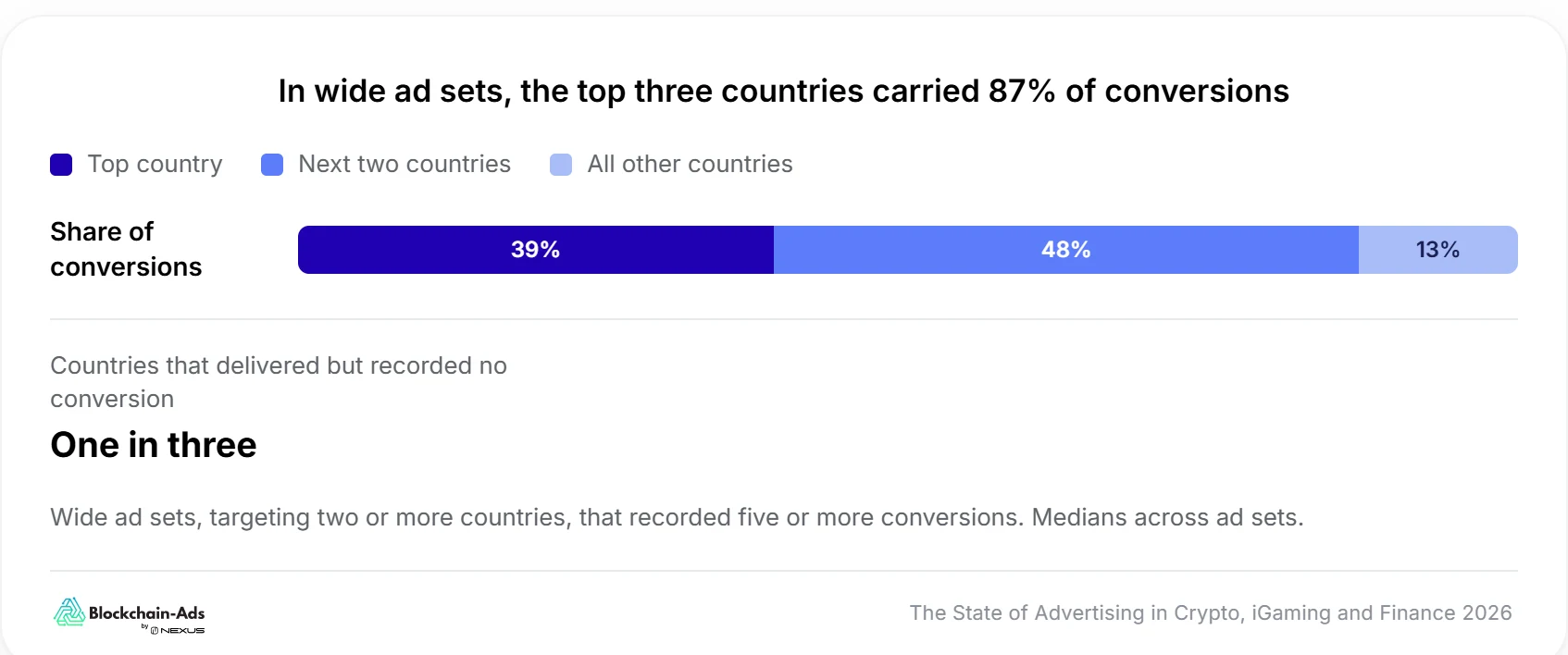
A multi-country campaign will tell you where there is interest. It won't necessarily tell you where you can get profitable acquisition. One campaign can cover multiple markets and look healthy overall, while most of its results come from just one or two countries.
Blockchain-Ads' report found that the top three countries accounted for 87% of conversions in multi-country ad sets with at least five recorded conversions. Check if your campaign has a similar split.
Source: Blockchain-Ads, The State of Advertising in Crypto, iGaming and Finance 2026.
Next, look beyond the first deposit. How much does it cost you to acquire a player in each country? What remains after the local costs?
If a country keeps producing solid results, give it its own ad set and budget.
Expert tip: Make the experience work for that market, too. Translating the advert won't help much if the player can't use their preferred payment method or get support in a language they understand.
Step 8: Fix the Problems That Make New Players Leave
Go through your own registration and payment process using a phone. Chances are you will find something your campaign reports cannot explain.
Maybe the verification process is unclear. Maybe a payment option appears in the advert but isn't actually available to the customer. Or perhaps finding some simple withdrawal information takes a visit to the help center.
Expert tip: Talk to your support team. Find out what new customers struggle with most. Share the feedback with acquisition and CRM teams. Repeated complaints give you very concrete and accurate feedback to investigate further.
Take the same approach to welcome offers. Check whether they leave you with customers who stay once the promotion ends, and whether the revenue they bring covers the cost.
High-LTV acquisition also needs a clear boundary. The UK Gambling Commission↗ says operators that offer high-value customer incentives should assess affordability, safer-gambling risk, and source of funds before inclusion.
Conclusion
Before you increase next month's budget, take a look at what happened to the players you paid to acquire a few months ago. Which sources brought people who stayed, and what did they contribute after costs? Those answers will tell you far more about where to spend next than another busy week of first deposits will.
FAQ
What is a high-LTV iGaming player?
A player whose projected contribution, after bonuses, taxes, payment fees and other costs, clearly exceeds what you paid to acquire them. Agree the exact definition with finance and use it in every acquisition report.
Why is first-deposit volume a poor success metric?
Many players leave once the welcome offer is used, and some cost more in bonuses and fees than they ever contribute. A source with fewer, pricier depositors can still leave you with more contribution after costs.
How should I compare affiliates?
Use the same reporting window for every partner and look at verification rates, fraud flags, players still active a month later, bonus spend and contribution after expenses, not just the number of first depositors.
When should a country get its own ad set?
When a multi-country campaign keeps producing solid results in that market after local costs. In Blockchain-Ads' sample, the top three countries carried 87% of conversions in wide ad sets.
Editor's note: this is a guest contribution. If you want help building this kind of acquisition and tracking setup for your own brand, you can contact the RedClaw team or see how agencies in this space compare in our iGaming marketing agency ranking.
About the author: Nadica Metuleva is a senior content writer at Blockchain-Ads with over 10 years of experience covering industries that rarely stand still, from crypto and finance to SaaS and digital marketing. Over the years, she's written for businesses and online publications, tackling everything from technical guides and reviews to industry trends.
Related Posts
- advertisingWhy iGaming Facebook Ads Get Rejected: Start With the Landing PageMost iGaming ad rejections are blamed on the creative when the landing page triggered them. Here is what a reviewer actually loads, why the same ad passes for one advertiser and fails for another, and how to isolate the element that got judged.
- igamingAverage ROAS in iGaming Affiliate Marketing (2025–2026 Data)What is the average ROAS in iGaming affiliate marketing? Working ranges of 3x–6x on 90-day NGR, by GEO, rev-share vs CPA, and traffic source, plus how to measure it.
- uncategorizedPerformance Marketing Complete Guide: Channels, Pricing Models & iGaming StrategyWhat performance marketing is, how it works, channels from affiliates to paid social, pricing models (CPA, CPL, RevShare), attribution, and why iGaming operators need it.