
Tag Page SEO Audit: What We Changed After Tag Clicks Fell 79% on an 80,000-Post Site
- RedClaw Performance Team
- RedClaw Performance Team
- Date
- Reading time
- 9 min read
TL;DR: On a large content site we took over, with roughly 80,000 posts, daily clicks to tag pages dropped from 98,570 to 20,977, a 79% fall. A full tag page SEO↗ audit turned up no single broken setting. It turned up a doorway-page profile: a median of 13 tags per post, 84% of tags attached to exactly one post, and 8,015 tag pages sharing one title template. We fixed it in a fixed order: protect the core tags that carry 80% of traffic, merge variants, then rewrite the rules. The rule most teams get wrong is noindex. "Noindex any tag with only one page" quietly kills tags that rank. Base it on post count instead. And before touching anything technical, check the top tags in URL Inspection: on this site, 40 of the top 40 were still indexed, which pointed to a quality problem, not a technical one.

Why tag pages carry the traffic and the risk
We took over an 80,000-post site where tag pages, generated automatically at almost no cost, carried most of the site's non-brand traffic, so when tag pages fail, the site loses its largest block of traffic.
Tag pages on a big content site cost almost nothing to create. Every new post with a handful of tags mints a handful of new indexable URLs. The site in question had about 80,000 posts, a median of 13 tags per post, and 8,131 tag pages getting impressions in Google. Most of its non-brand traffic landed on those pages. So when they went down, the biggest slice of the site went with them.
Tag page clicks fell 79%. Zooming out, non-brand traffic across the whole site had been sliding since 30 August 2026, down roughly 80% overall.
The instinct with a drop like that is to hunt for a technical fault: a bad robots rule, a canonical pointing the wrong way. Check those, sure. But tag page problems usually aren't one setting. They come from volume. Google's spam policies↗ describe doorway pages as large sets of similar pages built to rank for search queries without giving users anything extra. Auto-generated tag pages with one post each and identical titles match that description almost line for line. Bing's webmaster guidelines↗ take the same view of thin, auto-generated pages.
The six metrics we audit before changing anything
Before changing any tag pages, audit every tag, not a sample, against six metrics: tags per post, share of single-post tags, title templates, description length, variant tags, and sentence-style or privacy-sensitive tags.
We audited every tag, not a sample. Sampling misleads here: click a few popular tags and everything looks fine, while the damage sits in the long tail. These are the six metrics, with what this site showed:
| Metric | This site | What it signals |
|---|---|---|
| Tags per post | Median 13, top 10% at 18 | One-off tags keep getting created |
| Tags with only one post | 84% | Thousands of empty keyword pages |
| Title template | 8,015 tag pages on one template | No difference between pages |
| Meta description length | 78% under 70 characters | No page-level content |
| Variant tags | 208 core terms spread across 2,904 tags | Diluted signals, doorway pattern |
| Sentence-style and privacy-sensitive tags | 579 sentence-style, 217 naming real organisations, 498 touching private matters | Quality and privacy exposure |
The first four ask whether a page has anything on it. The last two ask whether it should exist at all. A variant tag is the same core term with a modifier, date or suffix bolted on, each getting its own page. When 208 terms fan out into 2,904 tags, each page ends up with a sliver of authority and one or two posts.
Cleanup order: lock the core, merge variants, then change the rules
Tag page cleanup should start by locking the 697 core tags that drive 80% of traffic, then merge variants, and change the noindex rules last, so bulk actions do not hit pages that still earn traffic.
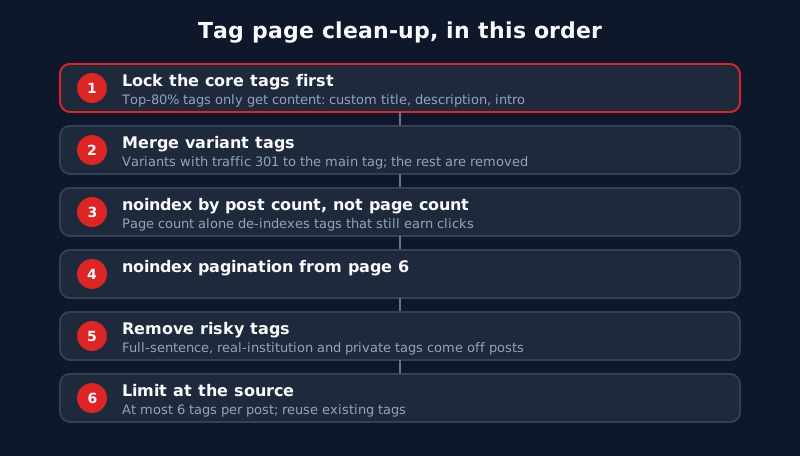
We ran the work in this order:
- Protect the core. 697 tags drove 80% of tag traffic. They got content work only: a custom title, a 140 to 160 character description, a short intro paragraph, and links to related tags. No URL changes, no noindex, no merging.
- Merge variants. Variants with traffic were 301-redirected to the main tag. Variants without traffic were removed from posts and kept noindex.
- Rewrite the noindex rule to use post count (next section).
- Noindex tag pagination from page 6 onward.
- Strip risky tags from posts: sentence-style tags, real names paired with an organisation, and anything touching private matters.
- Set rules at the source: six tags per post at most, reuse existing tags first, no sentences as tags.
The core list comes first because merges and noindex runs are bulk operations, and bulk operations always catch pages they shouldn't. Every later batch gets checked against that list. It's the same protect-first idea as the A tier in our piece on large-site content pruning.
Merges should be 301s, never 302s, and they should point at the main tag itself rather than a sorted or paginated version. Google's guide to consolidating duplicate URLs↗ treats redirects as the strongest consolidation signal. After merging, pull the old tags out of posts, listings and related-content widgets so the site stops linking to redirects. Tag pages also stay out of the sitemap. The full page-type table is in our guide to large-site indexing and sitemaps.
Base noindex on post count, not page count
A tag page noindex rule should be based on post count, not page count: tags with 3 or more posts stay indexed, and tags with 1 to 2 posts get noindex, because a single page does not mean thin content.
The original rule was "noindex a tag if it only has one page." Sounds reasonable until you notice one page can hold several posts. A popular tag with five posts can easily fit on a single page. The audit found 86 tags with more than 1,000 clicks over 16 months that had been noindexed by this rule.
The replacement rule:
| Posts on the tag | robots | In sitemap |
|---|---|---|
| 3 or more | index, follow | No |
| 1 to 2 | noindex, follow | No |
| Reaches 3 | Switches back to index automatically | No |
| Tag pagination, page 6+ | noindex, follow | No |
We use noindex, follow so crawlers still follow links through to the posts. Google's robots meta tag documentation↗ is clear that noindex controls whether a page appears in results, not whether its links are followed. The switch back has to be automatic. If someone has to flip it by hand, it never gets flipped. And if the same CMS also serves mirror domains that still earn Bing or Yandex traffic, a googlebot-only meta tag keeps the change scoped to Google. Yandex documents its own robots directives↗ separately.
Reading URL Inspection on core tags
If URL Inspection shows the top core tags are still indexed, as all 40 sampled were, the problem is a ranking drop rather than removal, so the fix belongs in content quality, not technical settings.
With clicks down 79%, the first question is whether the pages were dropped from the index or are still indexed but ranking lower. We ran the top 40 core tags through URL Inspection in Search Console. All 40 were indexed.
That 40/40 matters. Removal usually has a technical trail you can follow: a stray noindex, a wrong canonical, server errors. Indexed but sinking points to quality, which means the six metrics above, not robots.txt. Google's guide to debugging traffic drops↗ separates technical issues from site-wide quality reassessments for the same reason. Start with the top tags, not a random sample: if even those are gone, stop and look for a technical cause.
Control groups: their recovery isn't a recipe
A control site's recovery does not give you a recipe to copy: if that site changed nothing, Google simply re-evaluated it, and your job is to reduce your own low-quality signals.
A similar site dropped over the same period, and later recovered. Ours didn't. The tempting move is to copy whatever the other site did.
So we asked its owner what they had changed. Nothing. A recovery with no changes means Google reassessed the site and let it back in. There's nothing to copy. The job is to bring your own low-quality signals down and wait for the next reassessment. A control group's real value is ruling out false stories, like assuming a recovery date marks a fix and spending two weeks recreating something that never happened.
Two things we haven't confirmed yet. We don't know whether this site's noindex and 410 rules went live around the 30 August 2026 cliff. That needs a deploy date from engineering. And the first 100 core tags have had their content work done, with two weeks of Search Console data still coming in. Until it does, we won't claim the content work helped.
This is one chapter of our large-site SEO guide, which maps all six workstreams and the order to tackle them in your first week.
FAQ
Should every tag page be noindexed?
No. Tags with three or more posts can stay indexed. Tags with one or two posts get noindex and switch back automatically at three. Core tags with traffic should get content work, not noindex.
Should variant tags be deleted or merged?
It depends on traffic. Variants with traffic get a 301 to the main tag. Variants without traffic come off the posts and stay noindex. Avoid turning thousands of tag URLs into 404s or 410s at once. A mass of error pages is a negative signal of its own.
How many tags should a post have?
We cap it at six, reuse existing tags first, and don't allow full sentences as tags. The cap stops one-off tags from piling up. This site's median of 13, with 84% of tags holding one post, is what no cap looks like.
If your site is sitting on thousands of tag pages and you're not sure which batch to tackle first, a tag audit is the first thing we run when we take on a large content site through our SEO site management service. "Lock the core tags first" always comes before any other change.
Related Posts
- strategyAI Content Quality Checklist for Bulk Publishing: 12 Pre-Publish Checks and a Front-End AuditAI publishing errors at scale are template errors: one bug ships in a dozen posts. Our 12 pre-publish checks, a front-end audit, and why auto-fixes need a lint.
- strategyContent Pruning for Large Sites: A/B/C Tiers, Red Lines and Hard Evidence for MergesContent pruning on a 10,000+ page site: tier pages with 16 months of data, noindex for Googlebot only, never mass-delete, and merge duplicates only on proof.
- strategyLarge Site Indexing: Page-Type Rules, Sitemap Hygiene, Mirrors and Multiple DomainsHow we manage indexing on content sites with hundreds of thousands of URLs: a page-type rulebook, four sitemap rules, canonical and 301 policy, mirror domains.